“Being is not full transcendence, the plenitude of the One or cosmic abundance, but rather an ellipsis, an absence, an incomprehensibly vast lack scattered with debris and detritus. Philosophy as the thinking of Being has to begin from the experience of disappointment that is at once religious (God is dead, the One is gone), epistemic (we know very little, almost nothing; all knowledge claims have to begin from the experience of limitation) and political (blood is being spilt in the streets as though it were champagne).”
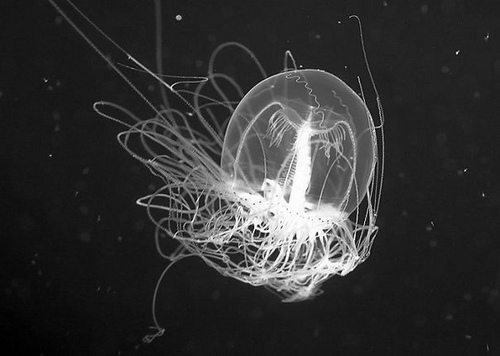
Turritopsis nutricula, the immortal jellyfish
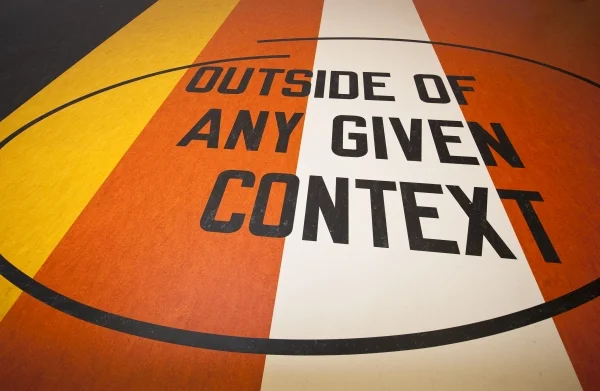
“a syntax– not, it follows, a semantics. For whereas semantics concern the production of meaning and the various processes of signification, a syntax ‘merely’ concerns the art of ordering things, of arranging and locating things (with certain orders, of both objects and concepts, tending to produce certain meanings). Here, one could discern a shared attachment to the original enterprise of art as a decidedly open-ended, non-decidable affair.
It is not so much art’s business to produce meaning (as a semantic view of art would have it), as it is to allow for various meanings to be extrapolated from it by the viewer, the visitor, he or she who wanders among art’s proverbial building blocks.”
-Dieter Roelstraete on Liam Gillick and Lawrence Weiner’s “A Syntax of Dependency”
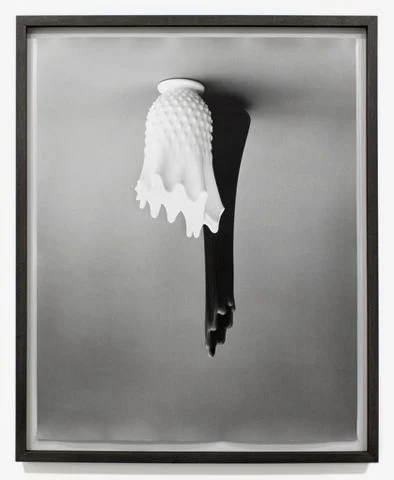
Talia Chetrit
“Scientific revolutions may be nothing more than metaphoric revolutions, in which autotelic novelties foreground the dramatization of a system in order to undermine the automatization of its reason. Paradigm shifts reveal that every axiology secretly involves a reductio ad absurdum – the anomaly of an irresistible, but inadmissible, theorem. The aporia of such a system arises paradoxically from the rigor of its logic as if its success also means its failure.”
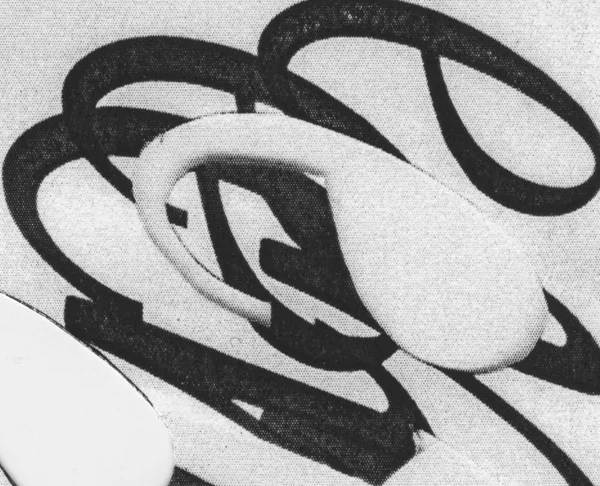
The Secret Life of Chaos →
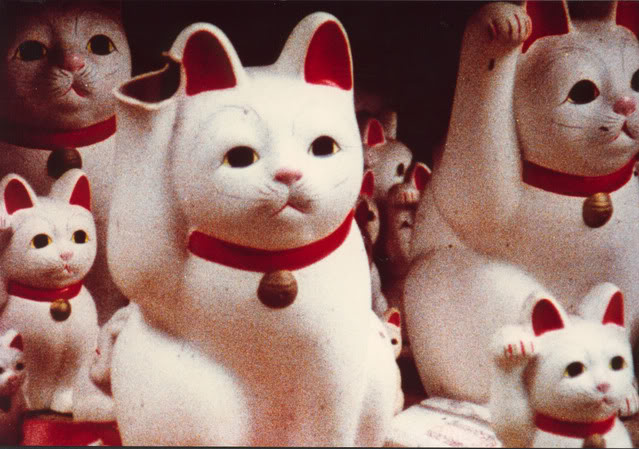
He wrote me: I will have spent my life trying to understand the function of remembering, which is not the opposite of forgetting, but rather its lining. We do not remember, we rewrite memory much as history is rewritten. How can one remember thirst?
“An epiphenomenon is that which is superinduced upon a phenomenon. Pataphysics, whose etymological spelling should be epi (meta ta phusika) and actual orthography ‘pataphysics, preceded by an apostrophe so as to avoid a simple pun, is the science of that which is superinduced upon metaphysics, whether within or beyond the latter’s limitations, extending as far beyond metaphysics as the latter extends beyond physics. Ex: an epiphenomenon being often accidental, pataphysics will be, above all, the science of the particular, despite the common opinion that the only science is that of the general. Pataphysics will examine the laws governing exceptions, and will explain the universe supplementary to this one; or, less ambitiously, will describe a universe which can be – and perhaps should be – envisaged in the place of the traditional one, since the laws that are supposed to have been discovered in the traditional universe are also correlations of exceptions, albeit more frequent ones, but in any case accidental data which, reduced to the status of unexceptional exceptions, possess no longer even the virtue of originality.DEFINITION. Pataphysics is the science of imaginary solutions, which symbolically attributes the properties of objects, described by their virtuality, to their lineaments.Contemporary science is founded upon the principle of induction: most people have seen a certain phenomenon precede or follow some other phenomenon most often, and conclude therefrom that it will ever be thus. Apart from other considerations, this is true only in the majority of cases, depends upon the point of view, and is codified only for convenience - if that! Instead of formulating the law of the fall of a body toward a center, how far more apposite would be the law of the ascension of a vacuum toward a periphery, a vacuum being considered a unit of non-density, a hypothesis far less arbitrary than the choice of a concrete unit of positive density such as water?For even this body is a postulate and an average man’s point of view, and in order that its qualities, if not its nature, should remain fairly constant, it would be necessary to postulate that the height of human beings should remain more or less constant and mutually equivalent. Universal assent is already a quite miraculous and incomprehensible prejudice. Why should anyone claim that the shape of a watch is round - a manifestly false proposition since it appears in profile as a narrow rectangular construction, elliptic on three sides; and why the devil should one only have noticed its shape at the moment of looking at the time? - Perhaps under the pretext of utility. But a child who draws a watch as a circle will also draw a house as a square, as a facade, without any justification, of course; because, except perhaps in the country, he will rarely see an isolated building, and even in a street the facades have the appearance of very oblique trapezoids.We must, in fact, inevitably admit that the common herd (…) is too dimwitted to comprehend elliptic equations, and that its members are at one in a so-called universal assent because they are capable of perceiving only those curves having a single focal point, since it is easier to coincide with one point rather than with two. These people communicate and achieve equilibrium by the outer edge of their bellies,’ tangentially. But even the common herd has learned that the real universe is composed of ellipses, and tradesmen keep their wine in barrels rather than cylinders.”
Oblique Strategies →
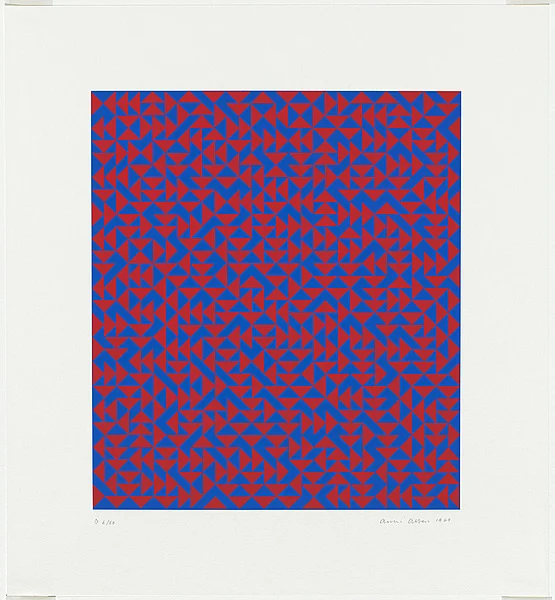
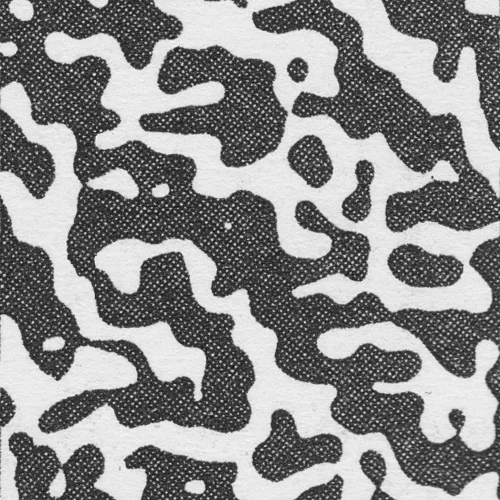
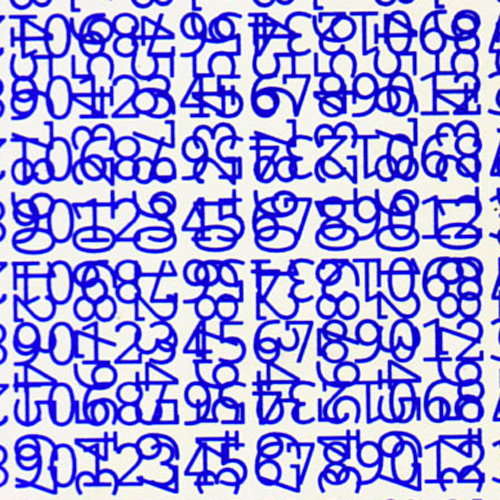
“But perhaps the most salutary effect of invisible art lies in the chameleon-like array of meanings which have cloaked it over the past half century. Rather than simply serving as a static limit defining the no-go zone of artistic practice, it has alternately appeared under the guise of the Sublime, of social idealism, avant-garde aggression, personal humility and ironic commentary. No single artist has been able to possess invisibility as a signature medium, and its wayward history gently yet pointedly mocks our waning belief in the cult of originality. It suggests instead that art doesn’t begin and end in a physical frame or a singular context, but lives on in the potentially endless process by which we make use of it.”
Ralph Rugoff, “Touched By Your Presence”
frieze issue 50, Jan-Feb 2000

“This bullet is an old one.In 1897, it was fired at the president of Uruguay by a young man from Montevideo, Avelino Arredondo, who had spent long weeks without seeing anyone so that the world might know that he acted alone. Thirty years earlier, Lincoln had been murdered by that same ball, by the criminal or magical hand of an actor transformed by the words of Shakespeare into Marcus Brutus, Caesar’s murderer. In the mid-seventeenth century, vengeance had employed it for the assassination of Sweden’s Gustavus Adolphus in the midst of the public hecatomb of battle.In earlier times, the bullet had been other things, because Pythagorean metempsychosis is not reserved for humankind alone. It was the silken cord given to viziers in the East, the rifles and bayonets that cut down the defenders of the Alamo, the triangular blade that slit a queen’s throat, the wood of the Cross and the dark nails that pierced the flesh of the Redeemer, the poison kept by the Carthaginian chief in an iron ring on his finger, the serene goblet that Socarates drank down one evening.In the dawn of time it was the stone that Cain hurled at Abel, and in the future it shall be many things that we cannot even imagine today, but that will be able to put an end to men and their wondrous, fragile life.”
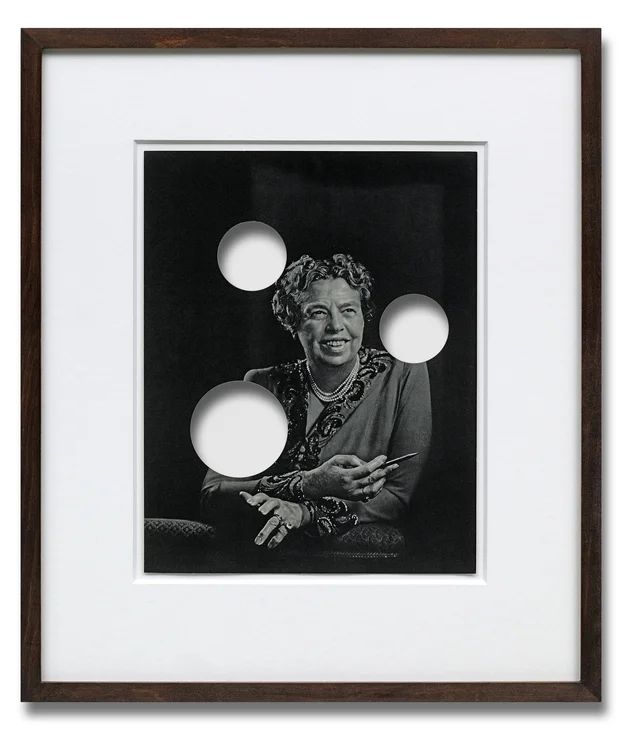
Cerith Wyn Evans
Untitled (Anna Eleanor Roosevelt), 2003
“In one of his last novels, the poet Aragon quite appropriately mentioned the idea put forward by a few isolated linguists of the century concerning the intermittence of recollecting and forgetting in the development of language, and the historical role of oblivion which is compensated for by verbal creativeness.Over the centuries, the science of language has more than once addressed the question of ellipsis which manifests itself at different verbal levels: sounds, syntax, and narration. One must admit that for the most part these questions, too, have been elaborated only episodically and fragmentarily. A technique which today receives even less consideration is that of elliptical perception, by which the listener fills in (again on all linguistic levels) whatever has been omitted by him as listener. We have also failed to appreciate properly the subjectivism of the hearer, who fills in the elliptic gaps creatively. Here lies the heart of the issue of disambiguation, which has been the object of considerable debate for the past few years within the science of language.From this angle one of the essential differences between spoken and written language can be seen clearly. The former has a purely temporal character, whereas the latter connects time and space. While the sounds that we hear disappear, when we read we usually have immobile letters before us and the time of the written flow of words is reversible: we can read and re-read, and, what is more, we can be ahead of an event. Anticipation, which is subjective in the listener, becomes objective in the reader, who can read the end of a letter or novel before reading the earlier parts.”
“Among ellipsis theorists there are two popular ideas about what an ellipsis is made of. On the one hand, it is a garden-variety phrase, similar in all respects to an overt phrase, but not interpreted phonologically. On the other, ellipses are a specialized sort of silent word, maybe along the lines of the silent pronouns that languages like Japanese or Italian are thought to have. This second “proform” approach is appealing as it makes sense of the similarities ellipses have with overt pronominals in finding antecedents from their contexts. If proforms are defined as having denotations that make use of contextual information, then analyzing ellipses as proforms explains this fact about them. And to the extent that the way in which pronouns access contextual information is like the way that ellipses do, we have evidence for equating them.”

Roman Opalka