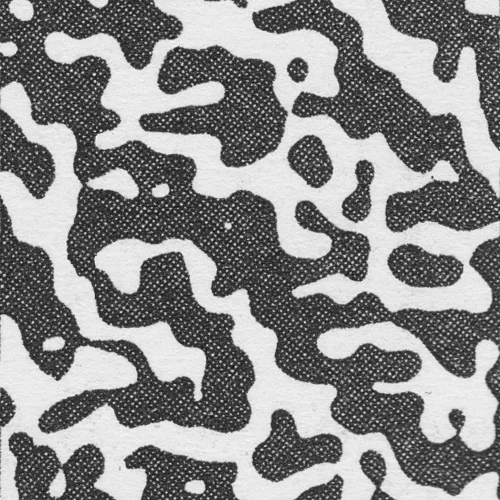
Photographs of magnetism by Ling Meng
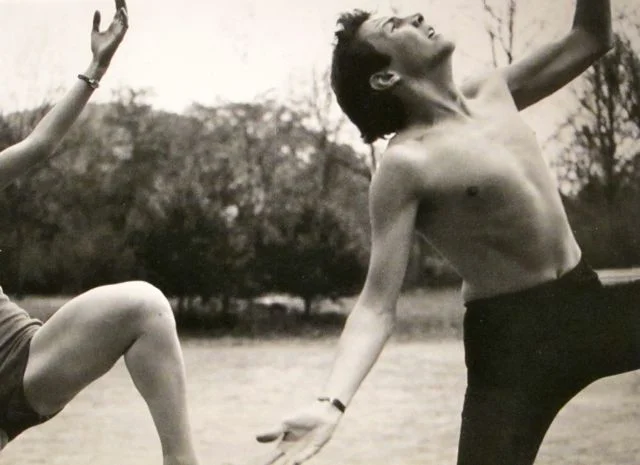
Robert Rauschenberg and Elizabeth Schmitt Jennerjahn at Black Mountain College

Alexander Gutke, The White Light of The Void, 2002
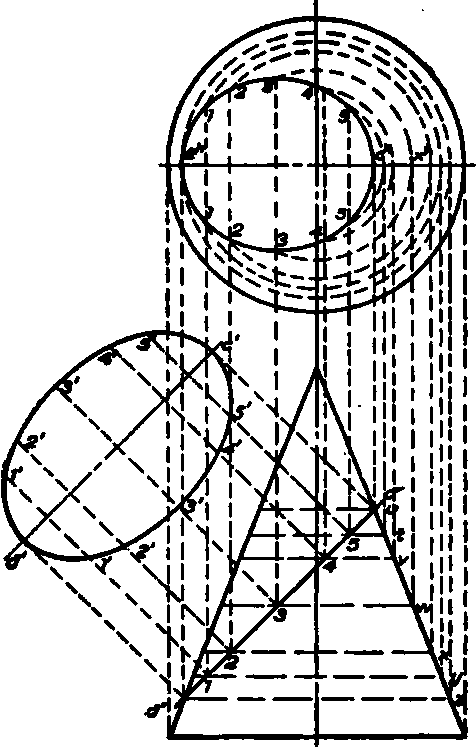
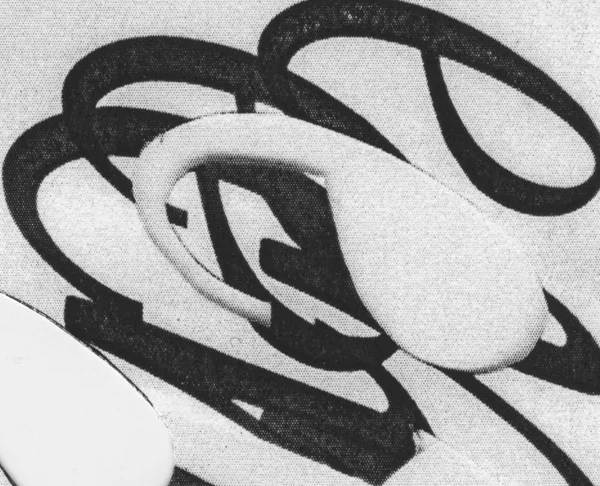
An ellipse is a plane curve that results from the intersection of a cone by a plane in a way that produces a closed curve. It is the locus of all points of the plane whose distances to two fixed points add to the same constant.
“But the oddest thing was the oval shape of the saint’s golden halo: it was like a hole into which he was disappearing head first. All the rest of the image was flat and depthless and without background, kind of blandly omnipresent - but then suddenly you got this other dimension entirely: an absence, a slipping away. When I asked Mavsek about it he told me that the visual motif was called ellipsus, but added that this motif didn’t properly belong to this type of image. For some reason, he was copying the painting twice, so there were three saints, three mountains, three oceans, goodness knows how many ships, being formed in front of me while I sat drinking coffee after coffee.”
The Living Dead: Three Films About the Power of the Past →
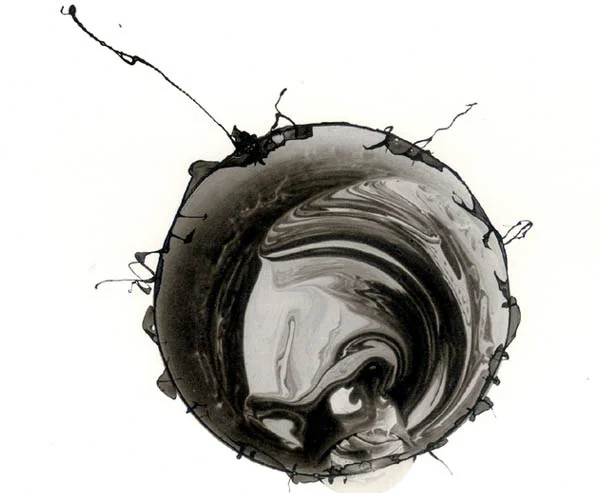
Roland Flexner, Bubble Drawings

Double Take, a film by director Johan Grimonprez and author Tom McCarthy
“Being is not full transcendence, the plenitude of the One or cosmic abundance, but rather an ellipsis, an absence, an incomprehensibly vast lack scattered with debris and detritus. Philosophy as the thinking of Being has to begin from the experience of disappointment that is at once religious (God is dead, the One is gone), epistemic (we know very little, almost nothing; all knowledge claims have to begin from the experience of limitation) and political (blood is being spilt in the streets as though it were champagne).”
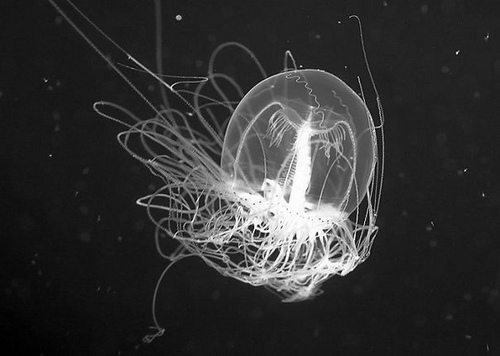
Turritopsis nutricula, the immortal jellyfish
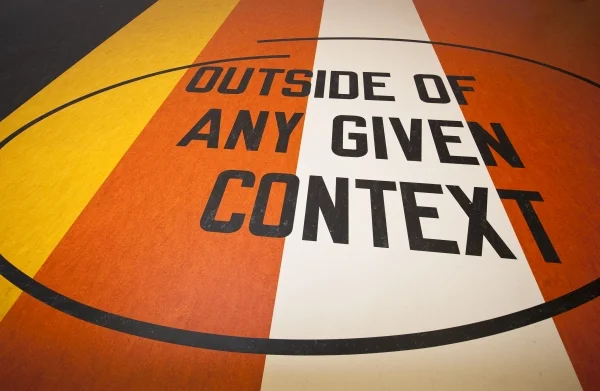
“a syntax– not, it follows, a semantics. For whereas semantics concern the production of meaning and the various processes of signification, a syntax ‘merely’ concerns the art of ordering things, of arranging and locating things (with certain orders, of both objects and concepts, tending to produce certain meanings). Here, one could discern a shared attachment to the original enterprise of art as a decidedly open-ended, non-decidable affair.
It is not so much art’s business to produce meaning (as a semantic view of art would have it), as it is to allow for various meanings to be extrapolated from it by the viewer, the visitor, he or she who wanders among art’s proverbial building blocks.”
-Dieter Roelstraete on Liam Gillick and Lawrence Weiner’s “A Syntax of Dependency”
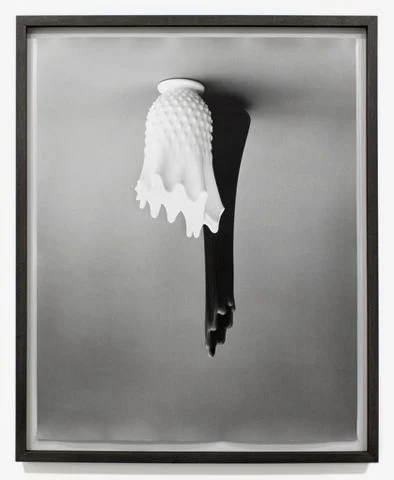
Talia Chetrit
“Scientific revolutions may be nothing more than metaphoric revolutions, in which autotelic novelties foreground the dramatization of a system in order to undermine the automatization of its reason. Paradigm shifts reveal that every axiology secretly involves a reductio ad absurdum – the anomaly of an irresistible, but inadmissible, theorem. The aporia of such a system arises paradoxically from the rigor of its logic as if its success also means its failure.”
The Secret Life of Chaos →
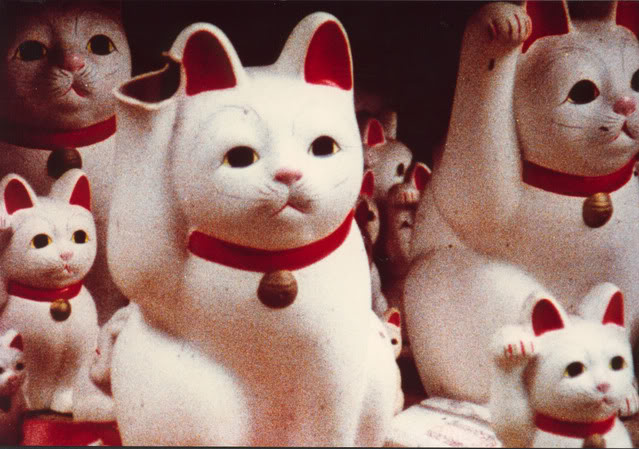
He wrote me: I will have spent my life trying to understand the function of remembering, which is not the opposite of forgetting, but rather its lining. We do not remember, we rewrite memory much as history is rewritten. How can one remember thirst?
“An epiphenomenon is that which is superinduced upon a phenomenon. Pataphysics, whose etymological spelling should be epi (meta ta phusika) and actual orthography ‘pataphysics, preceded by an apostrophe so as to avoid a simple pun, is the science of that which is superinduced upon metaphysics, whether within or beyond the latter’s limitations, extending as far beyond metaphysics as the latter extends beyond physics. Ex: an epiphenomenon being often accidental, pataphysics will be, above all, the science of the particular, despite the common opinion that the only science is that of the general. Pataphysics will examine the laws governing exceptions, and will explain the universe supplementary to this one; or, less ambitiously, will describe a universe which can be – and perhaps should be – envisaged in the place of the traditional one, since the laws that are supposed to have been discovered in the traditional universe are also correlations of exceptions, albeit more frequent ones, but in any case accidental data which, reduced to the status of unexceptional exceptions, possess no longer even the virtue of originality.DEFINITION. Pataphysics is the science of imaginary solutions, which symbolically attributes the properties of objects, described by their virtuality, to their lineaments.Contemporary science is founded upon the principle of induction: most people have seen a certain phenomenon precede or follow some other phenomenon most often, and conclude therefrom that it will ever be thus. Apart from other considerations, this is true only in the majority of cases, depends upon the point of view, and is codified only for convenience - if that! Instead of formulating the law of the fall of a body toward a center, how far more apposite would be the law of the ascension of a vacuum toward a periphery, a vacuum being considered a unit of non-density, a hypothesis far less arbitrary than the choice of a concrete unit of positive density such as water?For even this body is a postulate and an average man’s point of view, and in order that its qualities, if not its nature, should remain fairly constant, it would be necessary to postulate that the height of human beings should remain more or less constant and mutually equivalent. Universal assent is already a quite miraculous and incomprehensible prejudice. Why should anyone claim that the shape of a watch is round - a manifestly false proposition since it appears in profile as a narrow rectangular construction, elliptic on three sides; and why the devil should one only have noticed its shape at the moment of looking at the time? - Perhaps under the pretext of utility. But a child who draws a watch as a circle will also draw a house as a square, as a facade, without any justification, of course; because, except perhaps in the country, he will rarely see an isolated building, and even in a street the facades have the appearance of very oblique trapezoids.We must, in fact, inevitably admit that the common herd (…) is too dimwitted to comprehend elliptic equations, and that its members are at one in a so-called universal assent because they are capable of perceiving only those curves having a single focal point, since it is easier to coincide with one point rather than with two. These people communicate and achieve equilibrium by the outer edge of their bellies,’ tangentially. But even the common herd has learned that the real universe is composed of ellipses, and tradesmen keep their wine in barrels rather than cylinders.”