Alexandra Leykauf

Einstein! Finally!
Nick Oberthaler

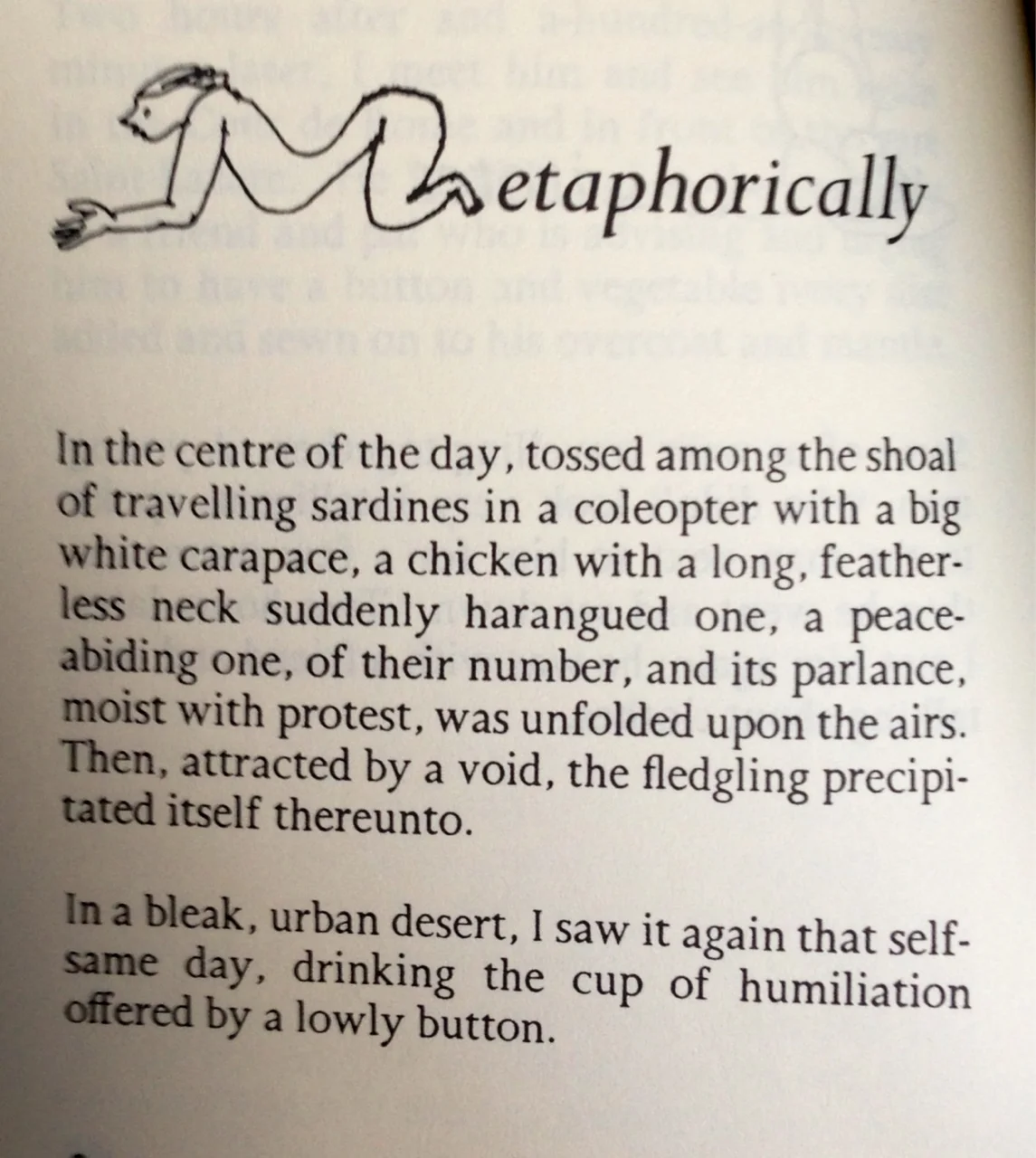
Raymond Queneau: Exercises in Style
They would drag us to this place, where we would become entangled matter, outside of any categories of identification and possession. We would be waveforms leaving behind individuality and subjectivity to become locked in the paradoxical objectivity of quantum realities. →
Graham Meyer: LET’S EAT GRAMMAR
Eely but pragmatist, language accomplishes its ends but resists revealing its inner life. The purpose of language is communication, and so when its business is done, most messages evanesce without a second thought, their interlocutors heedless of the theoretical matrices they’re supporting or opposing. Language is a tool, a medium, a vehicle. The successful use of language results in the successful transmission of a message.
a fact of course as one agreed no doubt true enough
Mars: Curiosity Descent
“But what if the existence of such a world is an illusion? What if there is no world before signs, no ultimate presence, no pre-semiotic speech, no possibility of specie, no redemption by gold, no grounding of signs in an origin, no intrinsic self-signifying icon of value? If all signs owe their being to, and are necessarily preceded by, other signs, if the signs are in principle inconvertible into non-signs,if the promise to deliver specie is necessarily void, then paper texts cease to be what they claim - secondary tokens representing a prior world - and become instead items in a world from which signs can never be absent. If such is the case, then what they took to be their ‘meaning’, to be delivered up as a relation to that signless world, becomes a phantom, a reification of an illusory presence. In short, paper texts would cease to ‘mean’ in the sense they themselves give to this term: they would not be able to be redeemed in terms more original, more ‘present’, more palpably ‘real’ than themselves: they would therefore be signs in a state of unacknowledged and irreparable dislocation from what they take to be their signifieds.”
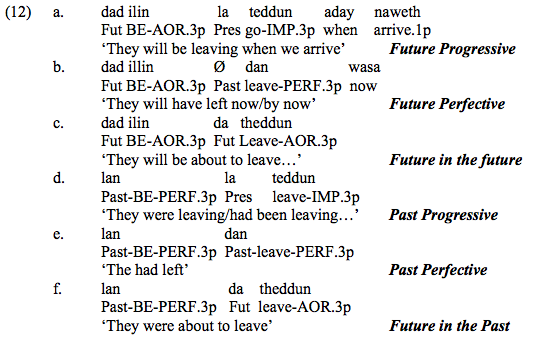
“According to B-theorists, there is no genuine change; rather, there is a permanent sequence of unchanging events, ordered (lined up, if you will) by an earlier-than/later-than relation. For example, World War I (and all the sub-events contained in it) is just as real as the event of your reading this preface, which in turn is just as real as the event of the death of the sun. When we say that World War I is past, we mean that it is earlier than the event of our utterance that World War I is past. When we say that the death of the sun is future, we mean that the death of the sun is later than our utterance that the death of the sun is future. In this sense, B-theorists consider reality to be “untensed”—-events are not intrinsically past, present, or future; rather, they simply exist (out there, somewhere), and ‘past’ and ‘future’ are merely ways of talking about where those events lie relative to the utterance events in which we speak about them. This view may seem counterintuitive, but it is most likely the received view in both physics and philosophy, having been advocated (or said to have been advocated) by figures ranging from Albert Einstein to Bertrand Russell.
According to A-theorists, on the other hand, time is not a frozen sequences of unchanging events. The picture given by A-theorists varies from theorist to theorist, but I will be defending an alternative due to A. N. Prior (and perhaps to Saint Augustine before him) in which, strictly speaking, there is no future and no past “out there” or anywhere. We can say that it will be true that a certain state of affairs (say, the death of the sun) will hold and that it was true that a certain state of affairs (say, World War I) held, but that this does not involve our referring to future and past events or to there being such events for us to refer to. According to this idea (often called presentism), what makes something future or past is how the world stands right now.”
Everything has always already begun
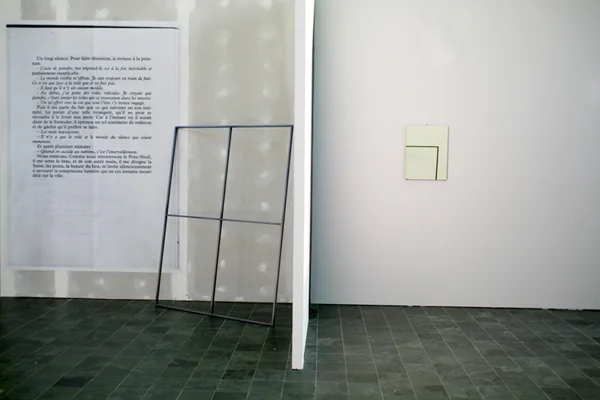
““Ghosts Before Breakfast” collects small gestures. Its observations might stutter, repeat, or double back, mistaking one for two, two for one, something for nothing. It is as interested in residues of things that aren’ t here as it is in the things that are. The objects tend to confuse their own negativity; their means and materials applied so directly as to become disorienting. Clarity verges on transparency. Eventually one sees through each artwork into a discrete, imperfect vacancy. What was concrete is bottomless.”