• SELECTED PROJECTS
  • NEWS
  • NOTES
  • CV
  • CONTACT

Cody Trepte

  • SELECTED PROJECTS
  • NEWS
  • NOTES
  • CV
  • CONTACT
“Ocean tides raised by the Moon put brakes on the Earth’s rotation, slowing the spin at a gradual but unpredictable rate. The deceleration has been ongoing for aeons. At the present pace, compared to the length of a day in atomic time, today stretches 2.5 milliseconds longer than yesterday, and tomorrow will gain 2.5 milliseconds over today. These small daily increments add up to almost one second over the course of a year, but the precise tally rises or falls at the whim of other factors influencing the Earth’s rotation. The more the Earth slows down in future, the more frequently a leap second will intervene in our affairs. They might come as often as quarterly by the year 2250, and then monthly by 2600.”
— The Wait of the World
Thursday 07.25.13
Posted by Cody Trepte
 

Conet Project 

Thinking again of Cocteau’s Orpheus 

Friday 07.05.13
Posted by Cody Trepte
 
“

John Archibald Wheeler, the visionary Princeton physicist who was Bohr’s disciple, once pointed out that the future and the past are theory. They exist only in records and the thoughts of the present, a fulcrum, in which all stories end and begin.


A single moment of insight or beauty or grace — like hitting a perfect towering drive off the eighth tee — can illuminate eternity.


It all depends on how you look at it.

”
— Timeless Questions About the Universe by Dennis Overbye nytimes.com, July 1st 2013
Tuesday 07.02.13
Posted by Cody Trepte
 
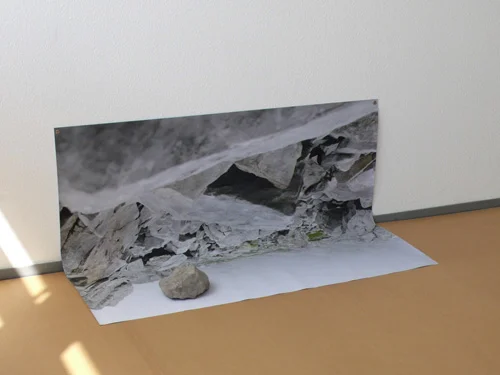
Helen Mirra Rock Mind (fog) 2009 color photograph, rock 54 x 135 x 54 cm

Helen Mirra
Rock Mind (fog)
2009
color photograph, rock
54 x 135 x 54 cm

Monday 07.01.13
Posted by Cody Trepte
 
Brent Wadden

Brent Wadden

Tuesday 06.25.13
Posted by Cody Trepte
 
Leander Herzog

Leander Herzog

Tuesday 06.04.13
Posted by Cody Trepte
 
Mike Creighton

Mike Creighton

Tuesday 06.04.13
Posted by Cody Trepte
 
Jean-Pierre Hébert

Jean-Pierre Hébert

Tuesday 06.04.13
Posted by Cody Trepte
 

Drawing with Code: Works from the Anne and Michael Spalter Collection →

Tuesday 06.04.13
Posted by Cody Trepte
 
Sam Lewitt

Sam Lewitt

Monday 06.03.13
Posted by Cody Trepte
 
tumblr_mnomu0f2mT1qbgkzxo1_1280.jpg
Friday 05.31.13
Posted by Cody Trepte
 
tumblr_mnombwSrLb1qbgkzxo1_1280.jpg
Friday 05.31.13
Posted by Cody Trepte
 
Jorinde VoigtDouglas R. Hofstadter, Gödel, Escher, Bach, „Die Air in G“,Achilles und die Schildkröte, 2013 Ink, pencil, gold leaf on paper262 x 152 cm

Jorinde Voigt
Douglas R. Hofstadter, Gödel, Escher, Bach, „Die Air in G“,Achilles und die Schildkröte, 2013
Ink, pencil, gold leaf on paper
262 x 152 cm

Tuesday 05.28.13
Posted by Cody Trepte
 
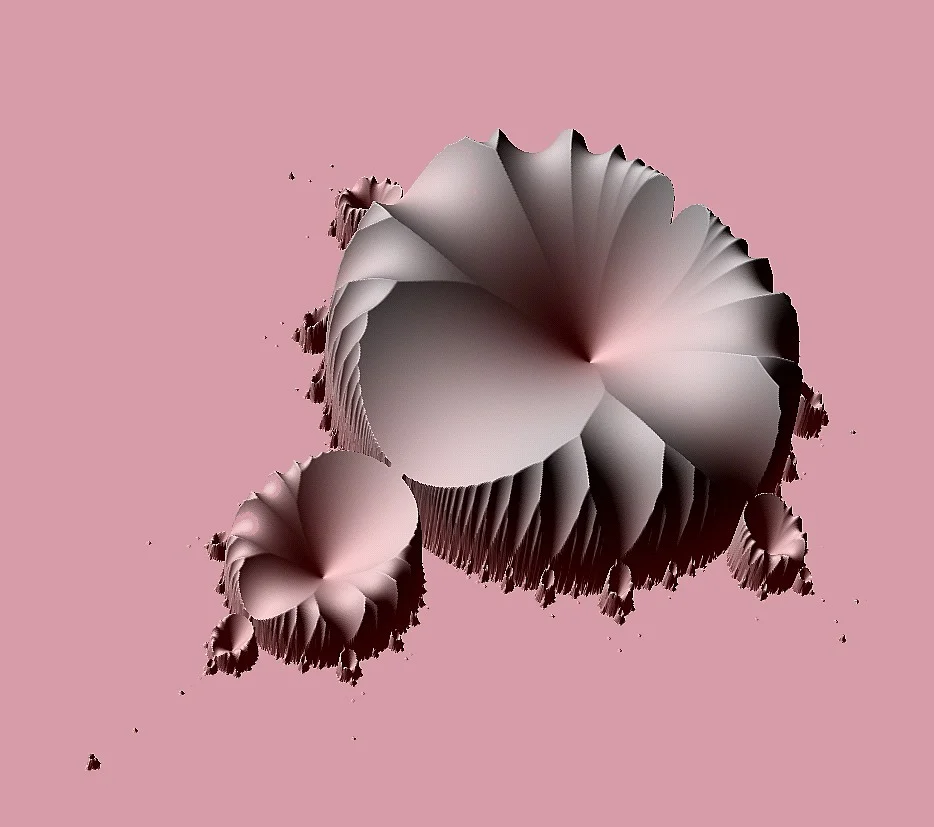
smallest absolute value of the orbit of the interior points of the mandelbrot set

smallest absolute value of the orbit of the interior points of the mandelbrot set

Sunday 05.26.13
Posted by Cody Trepte
 
“

A direct perception is present when I have it, and so is what is simultaneous with it. In the first place this definition involves a circle, for the words “when I have it,” can only mean “when it is present”. But if we left out these words, the definition would be false, for I have many direct presentations which are at different times, and which cannot, therefore, all be present, except successively. This, however, is the fundamental contradiction of the A series, which has been already considered. The point I wish to consider here is different.


The direct perceptions which I now have are those which now fall within my “specious present”. Of those which are beyond it, I can only have memory or anticipation. Now the “specious present ” varies in length according to circumstances, and may be different for two people at the same period. The event M may be simultaneous both with X’s perception Q and Y’s perception R. At a certain moment Q may have ceased to be part of X’s specious present. M, therefore, will at that moment be past. But at the same moment R may still be part of Y’s specious present. And, therefore, M will be present, at the same moment at which it is past.


This is impossible. If, indeed, the A series was something purely subjective, there would be no difficulty. We could say that M was past for X and present for Y, just as we could say that it was pleasant for X and painful for Y. But we are considering attempts to take time as real, as something which belongs to the reality itself, and not only to our beliefs about it, and this can only be so if the A series also applies to the reality itself. And if it does this, then at any moment M must be present or past. It cannot be both.

”
— The Unreality of Time by John Ellis McTaggart
Thursday 05.23.13
Posted by Cody Trepte
 
Peles Empire, Cabana IV, 2012

Peles Empire, Cabana IV, 2012

Sunday 05.19.13
Posted by Cody Trepte
 
Jesse Hlebo – All That Fits, 2012

Jesse Hlebo – All That Fits, 2012

Friday 05.17.13
Posted by Cody Trepte
 
Lucie Stahl – Face Off, 2012

Lucie Stahl – Face Off, 2012

Friday 05.17.13
Posted by Cody Trepte
 
tumblr_mmeaehDhb61qbgkzxo1_1280.jpg
Monday 05.06.13
Posted by Cody Trepte
 
“The hundred pages of that remarkable essay ring changes on a single geometrical theme: Euler’s law that the faces and vertices of a polyhedron together outnumber the edges by two. After explaining the classical proof, Lakatos produces an exception: a hollow solid whose surfaces are a cube within a cube. Its faces and vertices outnumber its edges by four. Then he examines the classical proof to see how it falls foul of such examples, and what stipulations would be suitable for excluding them. Having thus narrowed the scope of Euler’s law, he produces a further exception: a solid consisting of two tetrahedra with only an edge or vertex in common. A further tightening of the law is thus indicated, and still the exceptions are not at an end. A polyheron with a square tunnel through it occasions a further restriction; a cube with a penthouse on top occasions yet a further restriction; and so the dialectic of revision and exception goes its oscillating way.

The geometry is fascinating, but the purspose is philosophical. Lakatos is opposing the formalists’ conception of mathematical proofs, which represents them as effectively testable and, once tested, incontrovertible. He is opposing the notion, so central to logical positivism, that mathematics and natural science are methodologically unlike.”
— W. V. Quine’s review of Proofs and Refutations
Friday 05.03.13
Posted by Cody Trepte
 
Newer / Older