• SELECTED PROJECTS
  • NEWS
  • NOTES
  • CV
  • CONTACT

Cody Trepte

  • SELECTED PROJECTS
  • NEWS
  • NOTES
  • CV
  • CONTACT
“

THE BELIEVER: That’s interesting – I would have imagined the opposite: that translatability would be the condition of great writing – that what it means to have written something great is that there is something so powerful in it that can communicate even through the scrim of the worst translation.


ADAM THIRLWELL: Maybe novels cope better than poetry with being mutilated and deformed. Their style functions differently. The real problem is how much weight to put on the loss, or on the inevitability of loss. I think there are very many emotional or neurotic aspects to this. It’s often as if some people want to say that if something isn’t a pure substitute for the original, then it’s a failure – whereas surely in fact it’s just a likeness, and it would only be hysterical to attack a likeness for not being a perfect replacement. And one thing that does seem true is that often linguistic turns and tropes that can’t be repeated in a new language turn out not to be so crucial to a story’s stylistic essence: the essence turns out to be much more a cloud and mobile. It’s a vaster thing than maybe we used to think, a novel’s style. That’s one possible conclusion


THE BELIEVER: Thinking about it as “a likeness” is very relaxing. That comparison had never occurred to me. Did you think about it like that always, or are you only thinking about it like that since the project?


ADAM THIRLWELL: In fact, I’m stealing this idea from David Bellos, a Princeton professor and, more importantly, translator of Georges Perec and Ismail Kadare. Around the time I was first putting this project together, the NYT asked me to review his new book on translation: Is That A Fish In Your Ear? and one of his arguments is that we have to stop thinking of translation as substitution. “A translation is more like a portrait in oils.” I remember I loved this analogy so much that I wanted to write an extra digressive paragraph using Picasso – there’s this great thing Picasso once told Brassai which I’ve always loved: ‘I always aim for likeness. A painter has to observe nature, but must never confuse it with painting. It can be translated into painting only with signs.’ And I remember thinking, I want the Picasso of translation! The Bellos analogy is so good because it neatly shows how much more flexibility there could be in the way people think about translations: each one is just looking for equivalent signs, not perfect reproductions.

”
— Adam Thirdwell in conversation with The Believer on issue 42 of McSweeney’s
Monday 10.13.14
Posted by Cody Trepte
 
“

… the history of physics is littered with metaphorical leaps. Einstein grasped relativity while thinking about moving trains. Arthur Eddington compared the expansion of the universe to an inflated balloon. James Clerk Maxwell thought of magnetic fields as little whirlpools in space, which he called vortices. The Big Bang was just a cosmic firecracker. Schrödinger’s cat, trapped in a cosmic purgatory, helped illustrate the paradoxes of quantum mechanics. It’s hard to imagine string theory without its garden hose.


These scientific similes might seem like quaint oversimplifications, but they actually perform a much more profound function. As the physicist and novelist Alan Lightman writes, “Metaphor in science serves not just as a pedagogical device, but also as an aid to scientific discovery. In doing science, even though words and equations are used with the intention of having precise meaning, it is almost impossible not to reason by physical analogy, not to form mental pictures, not to imagine balls bouncing and pendulums swinging.” The power of a metaphor is that it allows scientists imagine the abstract concept in concrete terms, so that they can grasp the implications of their mathematical equations. The world of our ideas is framed by the only world we know.


But relying on metaphor can also be dangerous, since every metaphor is necessarily imperfect. (As Thomas Pynchon put it, “The act of metaphor is a thrust at truth and a lie, depending on where you are.”) The strings of the universe might be like a garden hose, but they are not a garden hose. The cosmos isn’t a plastic balloon. When we chain our theories to ordinary language, we are trespassing on the purity of the equation. To think in terms of analogies is to walk a tightrope of accuracy.

”
— The Future of Science…Is Art? by Jonah Lehrer in Seed Magazine
Tuesday 09.02.14
Posted by Cody Trepte
 
“Silence goes faster backwards. Three times. Twice, I repeat.”
— from Cocteau’s Orpheus
Saturday 08.23.14
Posted by Cody Trepte
 
“Literature, art, and philosophy represent different forms of intelligence – forms that, in the end, can probably be traced back to a single practice: the focused contemplation of the starry sky that seeks out patterns in it.”
— Nicolas Bourriaud on the INS
Saturday 08.23.14
Posted by Cody Trepte
 
Erlea Maneros Zabala

Erlea Maneros Zabala

Friday 08.22.14
Posted by Cody Trepte
 
“Short ideas, repeated, massage the brain”
— Robert Ashley
Thursday 07.10.14
Posted by Cody Trepte
 
Why would a cloud appear to be different colors? A relatively rare phenomenon known as iridescent clouds can show unusual colors vividly or a whole spectrum of colors simultaneously. These clouds are formed of small water droplets of nearly uniform …

Why would a cloud appear to be different colors? A relatively rare phenomenon known as iridescent clouds can show unusual colors vividly or a whole spectrum of colors simultaneously. These clouds are formed of small water droplets of nearly uniform size. When the Sun is in the right position and mostly hidden by thick clouds, these thinner clouds significantly diffract sunlight in a nearly coherent manner, with different colors being deflected by different amounts. Therefore, different colors will come to the observer from slightly different directions. Many clouds start with uniform regions that could show iridescence but quickly become too thick, too mixed, or too far from the Sun to exhibit striking colors. The above iridescent cloud was photographed in 2009 from the Himalayan Mountains in Nepal, behind the 6,600-meter peak named Thamserku.

Source: http://apod.nasa.gov/apod/astropix.html
Tuesday 07.08.14
Posted by Cody Trepte
 
“

For us, both as linguists and as ordinary word-users, the meaning of any linguistic sign is its translation into some further, alternative sign, especially a sign “in which it is more fully developed” as Peirce, the deepest inquirer into the essence of signs, insistently stated. The term “bachelor” may be converted into a more explicit designation, “unmarried man,” whenever higher explicitness is required. We distinguish three ways of interpreting a verbal sign: it may be translated into other signs of the same language, into another language, or into another, nonverbal system of symbols.
These three kinds of translation are to be differently labeled:
1. Intralingual translation or rewording is an interpretation of verbal signs by means of other signs of the same language.
2. Interlingual translation or translation proper is an interpretation of verbal signs by means of some other language.
3. Intersemiotic translation or transmutation is an interpretation of verbal signs by means of signs of nonverbal sign systems.


The intrallingual translation of a word uses either another, more or less synonymous, word or resorts to a circumlocution. Yet synonymy, as a rule, is not complete equivalence: for example, “every celibate is a bachelor, but not every bachelor is a celibate.” A word or an idiomatic phrase-word, briefly a code-unit of the highest level, may be fully interpreted only by means of an equivalent combination of code-units, i.e., a message referring to this code-unit: “every bachelor is an unmarried man, and every unmarried man is a bachelor” or “every celibate is bound not to marry, and everyone who is bound not to marry is a celibate?’


…


Syntactic and morphological categories, roots, and affixes, phonemes and their components (distinctive features)–in short, any constituents of the verbal code–are confronted, juxtaposed, brought into contiguous relation according to the principle of similarity and contrast and carry their own autonomous signification. Phonemic similarity is sensed as semantic relationship. The pun, or to use a more erudite, and perhaps more precise term–paronomasia, reigns over poetic art, and whether its rule is absolute or limited, poetry by definition is untranslatable. Only creative transposition is possible: either intralingual transposition–from one poetic shape into another, or interlingual transposition–from one language into another, or finally intersemiotic transposition–from one system of signs into another, e.g., from verbal art into music, dance, cinema, or painting.

”
— Roman Jakobson’s On Linguistic Aspects of Translation
Monday 07.07.14
Posted by Cody Trepte
 
“The task of the translator consxsts in finding that intended effect [Intention] upon the language into which he is translating which produces in it the echo of the original. This is a feature of translation which basically differentiates it from the poet’s work, because the effort of the latter is never directed at the language as such, at its totality, but solely and immediately at specific linguistic contextual aspects. Unlike a work of literature, translation does not find itself in the center of the language forest but on the outside facing the wooded ridge; it calls into it without entering, aiming at that single spot where the echo is able to give, in its own language, the reverberation of the work in the alien one. Not only does the aim of translation differ from that of a literary work–it intends language as a whole, taking an individual work in an alien language as a point of departure–but it is a different effort altogether. The intention of the poet is spontaneous, primary, graphic; that of the translator is derivative, ultimate, ideational. For the great motif of integrating many tongues into one true language is at work. This language is one in which the independent sentences, works of literature, critical judgments, will never communicate–for they remain dependent on translation, but in it the languages themselves, supplemented and reconciled in their mode of signification, harmonize. If there is such a thing as a language of truth, the tensionless and even silent depository of the ultimate truth which all thought strives for, then this language of truth is–the true language. And this very language, whose divination and description is the only perfection a philosopher can hope for, is concealed in concentrated fashion in translations. There is no muse of philosophy, nor is there one of translation. But despite the claims of sentimental artists, these two are not banausic. For there is a philosophical genius that is characterized by a yearning for that language which manifests itself in translations.”
— The Task of the Translator - Walter Benjamin
Saturday 07.05.14
Posted by Cody Trepte
 
“Pius Servien rightly distinguished two languages: the language of science, dominated by the symbol of equality, in which each term may be replaced by others; and lyrical language, in which every term is irreplaceable and can only be repeated. Repetition can always be ‘represented’ as extreme resemblance or perfect equivalence, but the fact that one can pass by degrees from one thing to another does not prevent their being different in kind.”
— Difference and Repetition - Gilles Deleuze
Saturday 07.05.14
Posted by Cody Trepte
 
“

How else can one write but of those things which one doesn’t know, or knows badly? It is precisely there that we imagine having something to say. We write only at the frontiers of our knowledge, at the border which separates our knowledge from our ignorance and transforms the one into the other. Only in this manner are we resolved to write. To satisfy ignorance is to put off writing until tomorrow - or rather, to make it impossible. Perhaps writing has a relation to silence altogether more threatening than that which it is supposed to entertain with death. We are therefore well aware, unfortunately, that we have spoken about science in a manner which was not scientific.


The time is coming when it will hardly be possible to write a book of philosophy as it has been done for so long: ‘Ah! the old style…’. The search for new means of philosophical expression was begun by Nietzsche and must be pursued today in relation to the renewal of certain other arts, such as the theatre or the cinema. In this context, we can now raise the question of the utilization of the history of philosophy. It seems to us that the history of philosophy should play a role roughly analogous to that of collage in painting. The history of philosophy is the reproduction of philosophy itself. In the history of philosophy, a commentary should act as a veritable double and bear the maximal modification appropriate to a double. (One imagines a philosophically bearded Hegel, a philosophically clean-shaven Marx, in the same way as a moustached Mona Lisa.) It should be possible to recount a real book of past philosophy as if it were an imaginary and feigned book. Borges, we know, excelled in recounting imaginary books. But he goes further when he considers a real book, such as Don Quixote, as though it were an imaginary book, itself reproduced by an imaginary author, Pierre Menard, who in turn he considers to be real. In this case, the most exact, the most strict repetition has as its correlate the maximum of difference (‘The text of Cervantes and that of Menard are verbally identical, but the second is almost infinitely richer…’). Commentaries in the history of philosophy should represent a kind of slow motion, a congelation or immobilisation of the text: not only of the text to which they relate, but also of the text in which they are inserted - so much so that they have a double existence and a corresponding ideal: the pure repetition of the former text and the present text in one another. It is in order to approach this double existence that we have sometimes had to integrate historical notes into the present text.

”
— Difference and Repetition - Gilles Deleuze
Saturday 07.05.14
Posted by Cody Trepte
 

The K Sound by Michael Portnoy

Saturday 06.28.14
Posted by Cody Trepte
 
“

JJ: Some of the art that’s had the biggest impact on me comes out of a history of critique, using strategies of self-reflexivity, or deconstructing the systems through which an artwork accrues value. I think now, though, those kinds of operations leave me more self-satisfied than curious. And what I really want from art at the end of the day is to be pushed to place that I don’t yet understand. That’s not to say that I’m after some sublime or mystical experience from art, or that art is better when it obscures reality. I think that the best curiosity-inducing art probably makes me want to live in the world differently in the end, so in that way, it’s productive for me in ways that “critical” art once was. I’m very interested in looking for the effects an artwork sets off—in my thinking, but also in the things it’s connected to.


AEB: I think that there’s a false binary between art that is critical and art that is undetermined or open-ended, and the notion that the former expresses itself didactically or straightforwardly to its object of critique, and the latter is frivolous and superficial. I think that a type of underdetermined play can in fact be a means towards critical understanding. The idea of being able to devolve into associative play and non-directed play is itself a form of critique, this is an idea I’m adapting from the psychoanalyst Jonathan Lear, who posits it at the intimate, psychological level; what we’ve been calling this kind of non-directional engineer, he’d simply call the analyst, but I think it also works as an aesthetic theory about the way that people come to a better understanding of their world.
That’s another way of saying what Jenny was saying about curiosity, which is a more flexible and usable form of critique.
MP: Curiosity is a nice word, because perhaps the kind of critique that falls short for us is one that doesn’t demonstrate or encourage curiosity.


TC: I agree. What I like about your 27 Gnosis project, for instance, is how it reminds that there is plenitude in the world, plenitude in language. We may encounter this plenitude more often in its absences and elisions, in our dissatisfaction with how the contemporary is choosing to narrate itself. But this should not suggest that those absent things are irrecoverable. The task of art, in other words, may be to open channels of access to that plenitude.

”
— BILGING A WETTER FLY’S LAP - a conversation between A.E. Benenson, Tyler Coburn, Jenny Jaskey, and Michael Portnoy from Mousse Issue #44
Saturday 06.28.14
Posted by Cody Trepte
 

Acéphale

A secret society including Bataille, Blanchot, Klossowski, and Callois. Because of its very nature, it is difficult to describe the society’s acts. Bataille referred several times to Marcel Mauss who had studied secret societies in Africa, describing them as a “total social phenomenon”. On this model, he organized several nocturnal meetings in the woods, near an oak which had been struck by lightning. Members of the Acéphale society were required to adopt several rituals, such as refusing to shake hand with anti-semites and celebrating the decapitation of Louis XVI, an event which prefigured the “chiefless crowd” targeted by “acéphalité”. Members of the society were also invited to meditation, on texts of Nietzsche, Freud, Sade and Mauss read during the assemblies. There was discussion amongst members about the possibility of carrying out a human sacrifice, but these discussions were never put into action.

Thursday 06.12.14
Posted by Cody Trepte
 
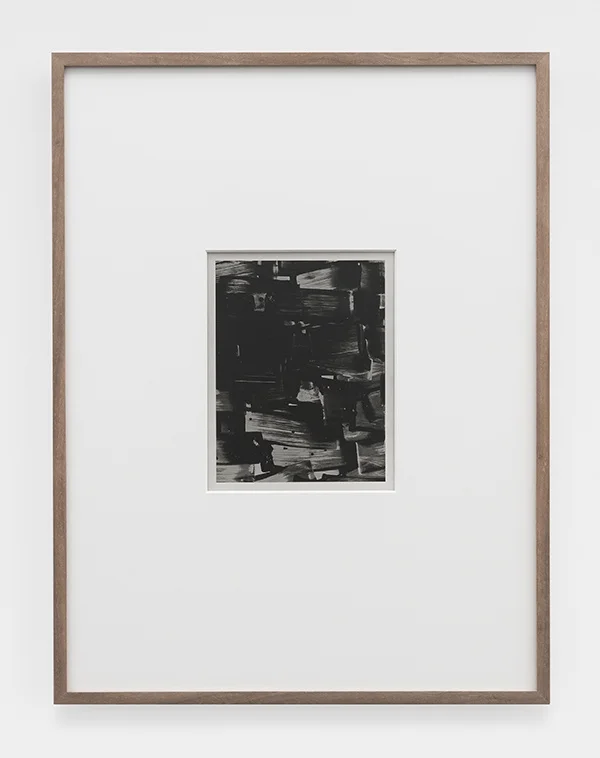
Anthony Pearson, Untitled (Solarization), 2011

Anthony Pearson, Untitled (Solarization), 2011

Saturday 05.31.14
Posted by Cody Trepte
 
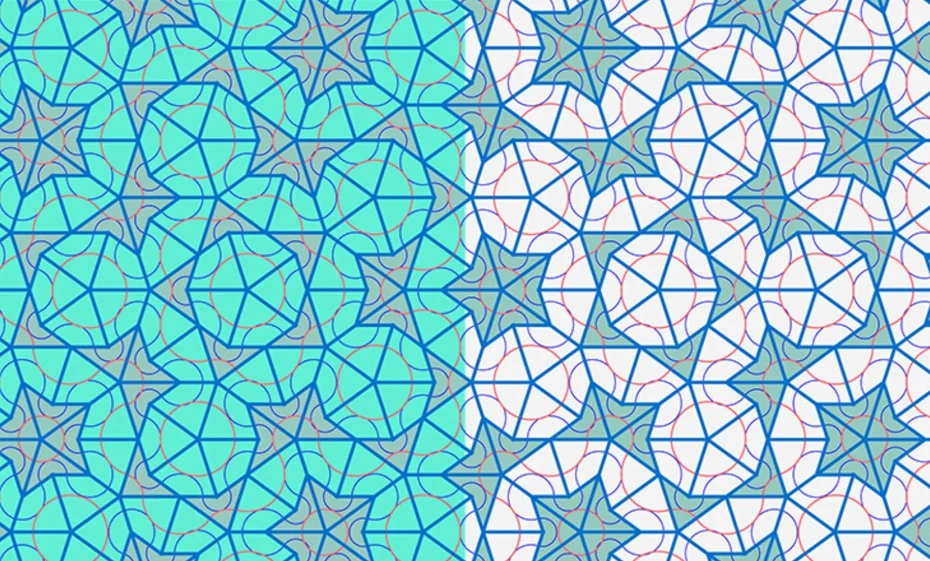
Forbidden Symmetry

Forbidden Symmetry

Source: http://nautil.us/issue/13/symmetry/impossi...
Friday 05.30.14
Posted by Cody Trepte
 
“The selection of entries arises from a double labor of exploration, both diachronic and synchronic. Diachrony allows us to reflect on crossings, transfers, and forks in the road: from Greek to Latin, from ancient Latin to scholastic then humanist Latin, with moments of interaction with a Jewish and an Arab tradition; from an ancient language to a vernacular; from one vernacular to another; from one tradition, system, or philosophical idiom to others; from one field of knowledge and disciplinary logic to others. In this way we reencounter the history of concepts, while marking out the turnings, fractures, and cariers that determine a “period.” Synchrony permits us to establish a state of play by surveying the present condition of national philosophical landscapes. We are confronted with the irreducibility of certain inventions and acts of forgetting: appearances without any equivalent, categories, false friends, intruders, doublings, empty contradictions, which register within a language the crystallization of themes and the specificity of an operation. We then wonder, on the basis of the modern works that are both the cause and the effect of the philosophical condition of a given language, why the terms we ordinarily consider as immediate equivalents have neither the same meaning nor the same field of application – what a thought can do in what a language can do.”
— Introduction to The Dictionary of Untranslatables by Barbara Cassin
Saturday 05.24.14
Posted by Cody Trepte
 

PangramTweets is a bot (a computer program that runs on its own) that searches Twitter for, and then retweets, pangrams—texts that contain every letter of the alphabet. A famous pangram, sometimes used as a typing test, is “The quick brown fox jumps over the lazy dog.” […]

Here’s a sampling of what has turned up so far.

I’ve just (with the help of google) realized I wrote about the wrong experiment in my 12 mark psychology question oops

— s (@bricktop___) May 13, 2014

It’s official: Arthur Sulzberger names Dean Baquet executive editor of The New York Times, replacing Jill Abramson.

— Vindu Goel (@vindugoel) May 14, 2014

Looking for a new job is exhausting. Every one I want requires a bazillion years of experience I don’t have. FML.

— Ryan Stephens (@Integrity1stziB) May 16, 2014

Thanks JMM for boosting my boxing prediction confidence again. The Mayweather card did a number on a lot of boxing fans. #MarquezAlvarado

— E.J.O. (@ElioOrtiz11) May 18, 2014

SHUT THE FUCK UP ABOUT THE “FRIENDZONE”. MAYBE YOU SHOULD JUST VALUE A WOMAN’S FRIENDSHIP AND QUIT EXPECTING THEM TO FUCK YOU. JESUS FUCK.

— ・。。・゜☆゜・。。・ (@chrstnmchd) May 19, 2014

Juan Manuel Marquez boxes Alvarado on weekday to line up fifth fight alongside Pacquiao @SportsMomentz http://t.co/e5CyDwDXFd

— Rinaldo Jonathan (@testeronline12) May 19, 2014

Maybe Joe needs to take some advice from Iceland and arrest the rich people who are stealing from the rest of us tax paying citizens. #qanda

— Toby Owens (@TehMegaWiz) May 19, 2014


From Language Log http://languagelog.ldc.upenn.edu/
By Ben Zimmer

Saturday 05.24.14
Posted by Cody Trepte
 

In Other Inquisitions, Borges writes of a strange taxonomy in an ancient Chinese encyclopedia:

On those remote pages it is written that animals are divided into (a) those that belong to the Emperor, (b) embalmed ones, © those that are trained, (d) suckling pigs, (e) mermaids, (f) fabulous ones, (g), stray dogs, (h) those that are included in this classification, (i) those that tremble as if they were mad, (j) innumerable ones, (k) those drawn with a very fine camel’s hair brush, (l) others, (m) those that have just broken a flower vase, (n) those that resemble flies from a distance.

This is fanciful, but it has the ring of truth — different cultures can classify the world in surprisingly different ways. In traditional Dyirbal, an aboriginal language of Australia, each noun must be preceded by a variant of one of four words that classify all objects in the universe:

bayi: men, kangaroos, possums, bats, most snakes, most fishes, some birds, most insects, the moon, storms, rainbows, boomerangs, some spears, etc.
balan: women, bandicoots, dogs, platypus, echidna, some snakes, some fishes, most birds, fireflies, scorpions, crickets, the hairy mary grub, anything connected with water or fire, sun and stars, shields, some spears, some trees, etc.
balam: all edible fruit and the plants that bear them, tubers, ferns, honey, cigarettes, wine, cake
bala: parts of the body, meat, bees, wind, yamsticks, some spears, most trees, grass, mud, stones, noises and language, etc.

“The fact is that people around the world categorize things in ways that both boggle the Western mind and stump Western linguists and anthropologists,” writes UC-Berkeley linguist George Lakoff in Women, Fire, and Dangerous Things (1987). “More often than not, the linguist or anthropologist just throws up his hands and resorts to giving a list — a list that one would not be surprised to find in the writings of Borges.”

“World View” from Futility Closet

Saturday 05.24.14
Posted by Cody Trepte
 
tumblr_n5utjw0d3V1qbgkzxo1_1280.jpg
tumblr_n5utjw0d3V1qbgkzxo2_1280.png
tumblr_n5utjw0d3V1qbgkzxo3_1280.png

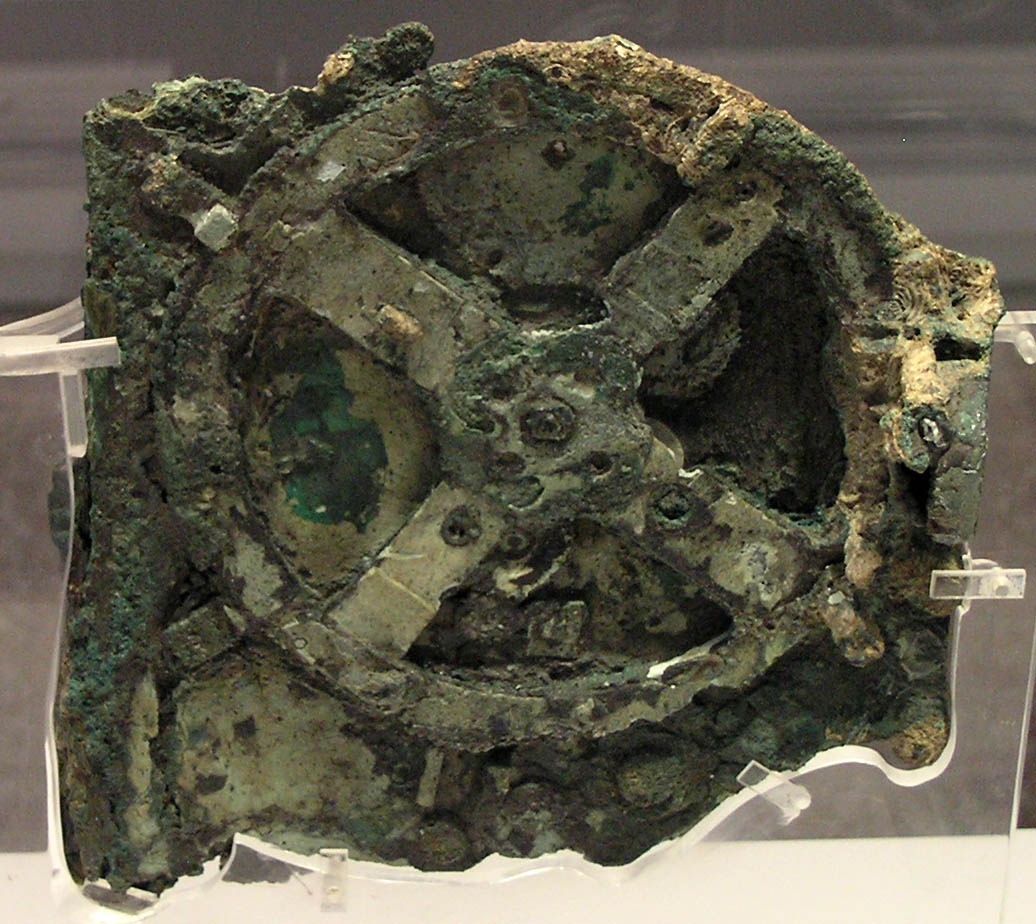
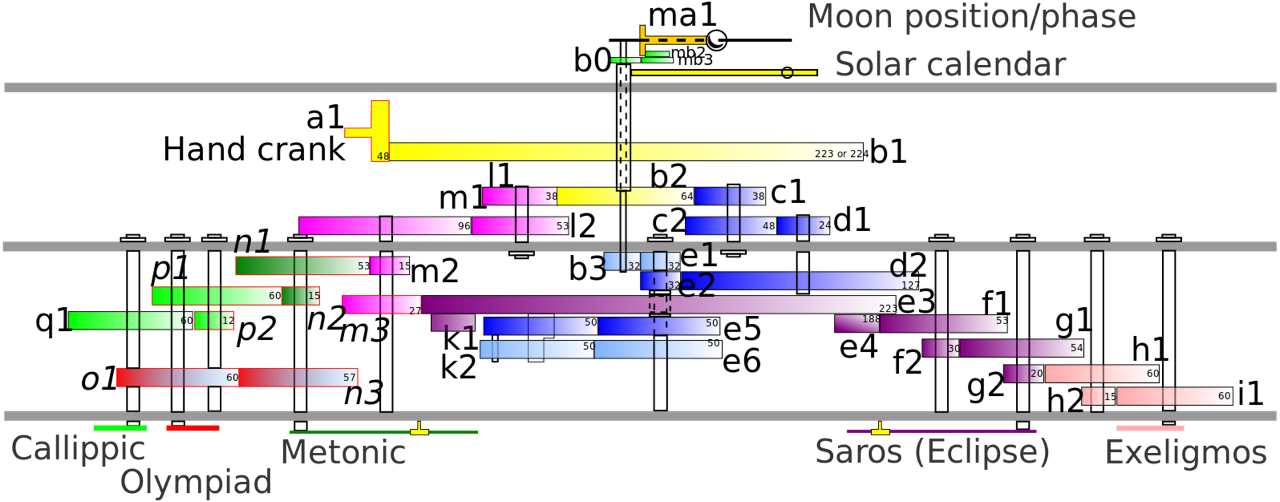
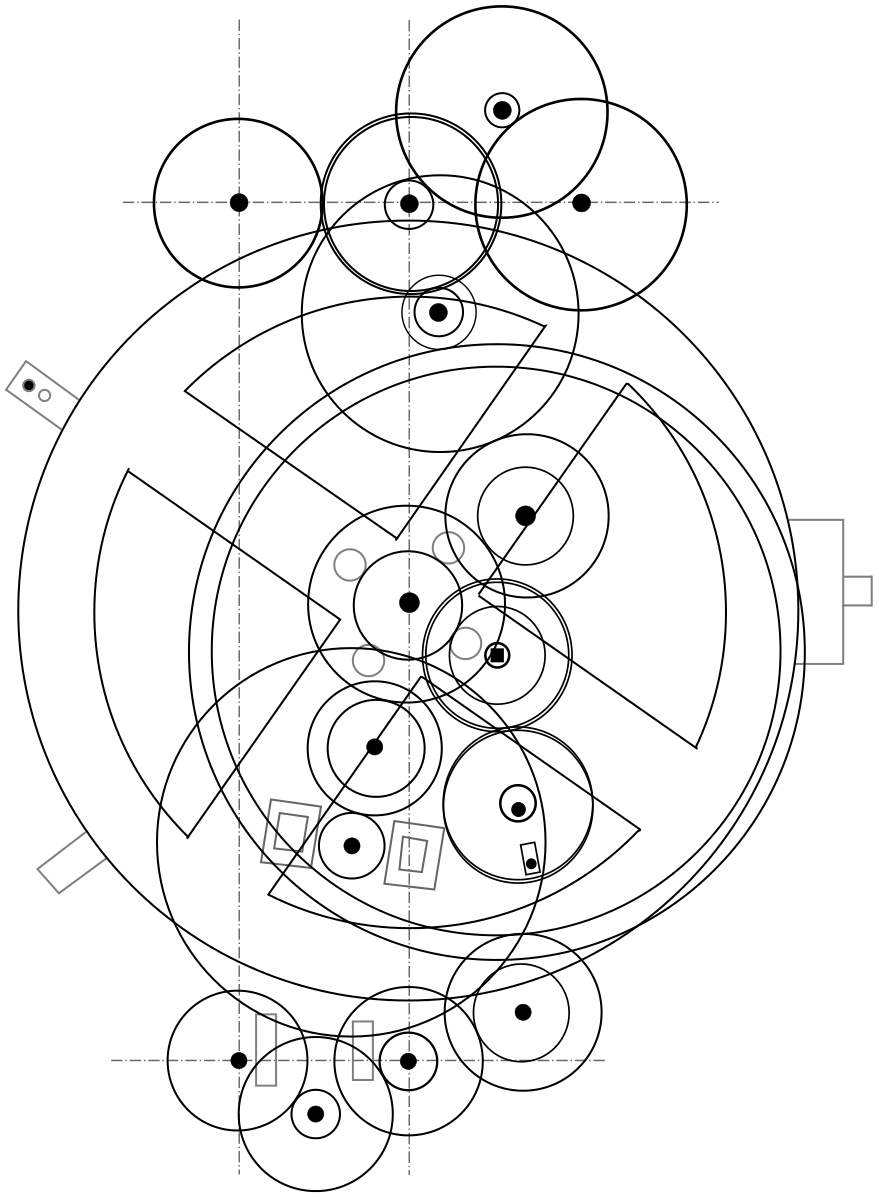
Antikythera mechanism

Monday 05.19.14
Posted by Cody Trepte
 
Newer / Older