
also, The Conet Project
Viking 1 Orbiter, image F035A72
“In short, it’s about subjectivity finding its assignations within material space and transmitted (or occluded) history, experience being dragged and catapulted along their ineluctably death-driven arcs.
Literature, in short, is not made up of ‘characters’: it understands that existence, whether individual or collective, is formed and unformed within networks of language and ceremony, spread across topographies whose axes, or gravitational force-fields, are law, pleasure and mortality, subject to the exigencies of topography itself. As such, it offers, at its deepest, neither commentary nor entertainment; rather, it is the very source-code of our being, index of its contingencies.”
Liz Harris at Nationale
“The experience startles him–not least because it plays out in the real and close-up space around the house an aspect of some scenes that he occasionally intuits but never quite pins down when riding the dial’s highest reaches: vague impressions of bodies hovering just beyond the threshold of the visible, and corresponding signals not quite separable from the noise around them–important ones, their recalcitrance all the more frustrating for that reason. He sees these things, and hears, or half-hears, them as well, quite frequently–usually as he’s straddling the wavelength-border between consciousness and sleep.”
Numbers stations →
“–Sometimes the best that’s possible is a stand-in or an approximation in order to manifest a desire for the internal. In the process you make notes inadvertently that reveal the gaps between a fantasy and one’s own ability. It becomes the same thing over and over. Then maybe it’s a confidence issue from then on. Coping with one’s fantasies. Drawing (on) something that’s out of reach so instead drawing the reach, or pretending to.–…A wanderer comes across a pile of chipped porcelain pieces. Set to work with glue, they construct an elegant saucer. When the previous owner, before they no longer had a use for it, first found the pile of chipped porcelain pieces they had constructed a teacup, and the owner before them a figurine of Adonis. Thus is the nature of history: many pieces always being found and then reconstructed.”
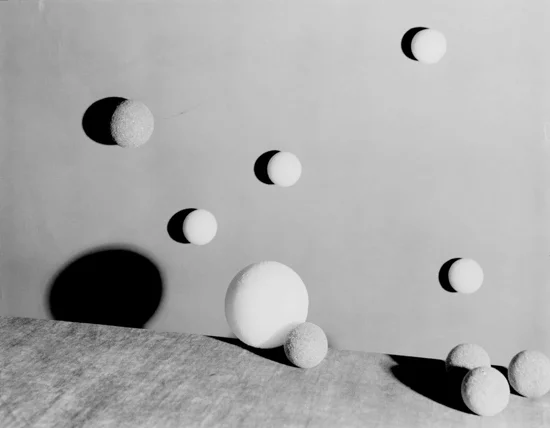
Sarah Conaway

Cerith Wyn Evans
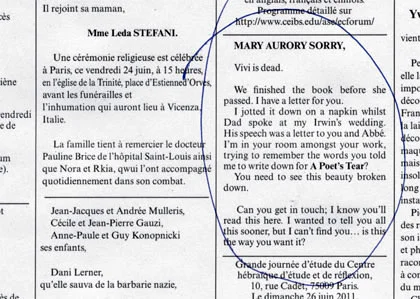
“If it is true that with each language that disappears from the world, something of the imaginary in the world disappears with it, then it is likewise true that with every language that is translated into another, that imaginary gets enriched, namely by an odyssey of searching and a subsequent fixing of meaning. Translation means jumping, and thus means beautiful renunciation. The beauty of this renunciation is what can perhaps at least be discerned in the act of translation.“ -”
“There will always be sludge that frustrates our efforts to implement the ideal in practice, not only in the present case but on all occasions. Sludge!… that unruly, refractory element in the world that, assuming the form of mechanical friction in one case, renders the perpetual motion machine impossible and that, assuming the form of Gödel’s theorem in another, renders the consistency of mathematics incapable of proof. Sludge is everywhere, it cannot be escaped, not only in the physical world but even in the realm of pure ideas. Although this principle of recalcitrance is familiar to all, it has been generally believed to be merely contingent in nature, a brute fact that has no intelligible warrant.”
“At this point we come across one of Heidegger’s most troubling formulations, that of the oblivion of being (Seinsvergessenheit), by which he refers to the forgetting of the forgetting of being, the withdrawal of its withdrawal, such that even the traces of being’s concealment have over time become lost and thus its question has become forgotten. On the surface this seems to be an inevitable consequence of his thinking of alētheia, but if this forgetting or withdrawal – and we must emphasize both insofar as each are translations of lēthē – is itself forgotten or withdrawn, then this doesn’t mean that it has simply vanished, for this would be to misread what takes place in forgetting. What is forgotten may not be available to be recalled but this lack punctuates thought and thus leaves a mark of forgetting which itself cannot be forgotten, even if it cannot be recalled.”
“One of the seats of emotion and memory in the brain is the amygdala, he explained. When something threatens your life, this area seems to kick into overdrive, recording every last detail of the experience. The more detailed the memory, the longer the moment seems to last. “This explains why we think that time speeds up when we grow older,” Eagleman said–why childhood summers seem to go on forever, while old age slips by while we’re dozing. The more familiar the world becomes, the less information your brain writes down and the more quickly time seems to pass.”
I am a New York Times crossword puzzle constructor. →
the coercive nostalgia present in the missing information of a picture that's been copied too many times... →
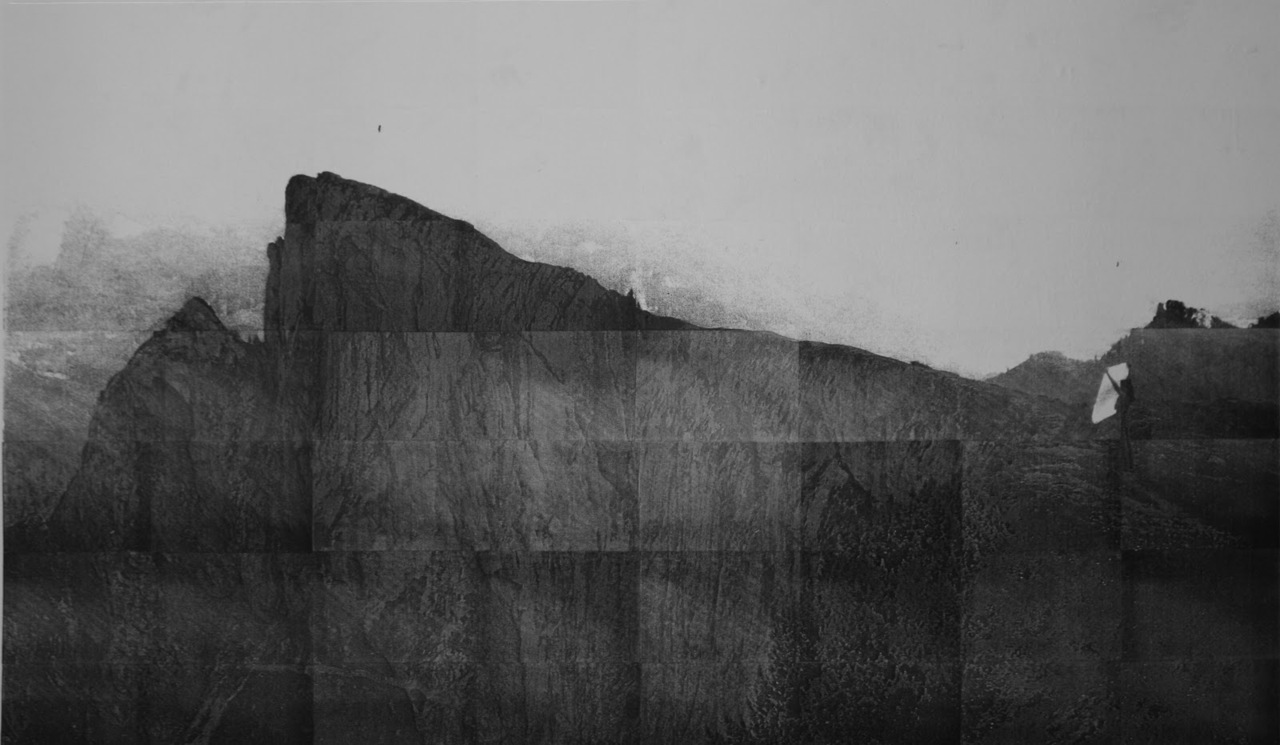
Amalia Pica Dialogue (paper and mountain). Image composed by A3 photocopies. Dimensions variable