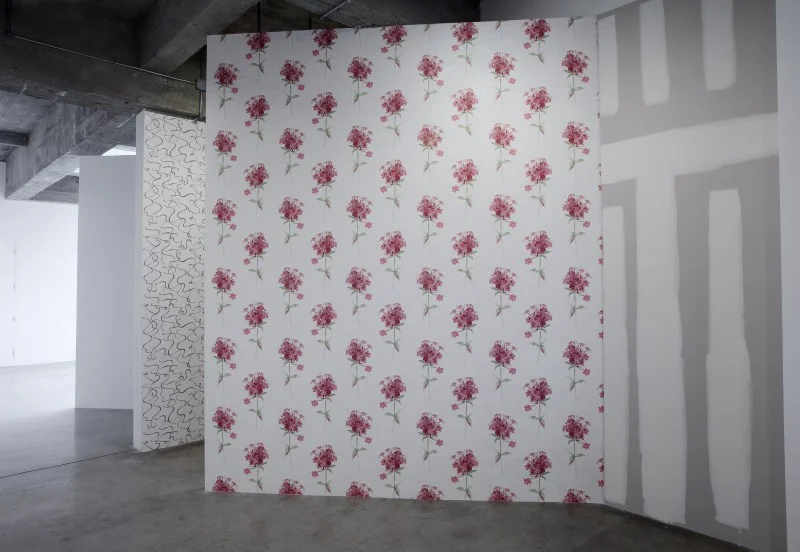
Shannon Ebner, Leaning Tree, 2002
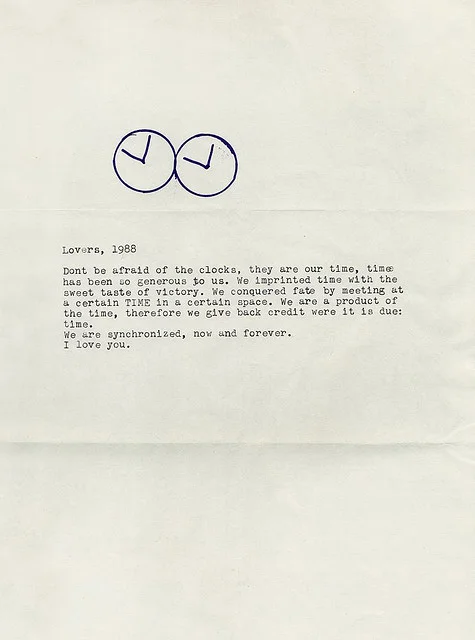
A Whole Lot of Nothing →
“I think this is another approach to the question we once formulated like this: how can we discover the obscure without exposing it to view? What would this experience of the obscure, in which the obscure offered itself in its obscurity, be?Yes, we were seeking then to circumscribe the affirmation of impossibility, this non-power that would not be a simple negation of power. And in asking ourselves what thought it might be that could not be thought in the mode of power and of appropriating comprehension, we came to say that ‘impossibility is the passion of the Outside itself,’ and also that ‘impossibility is the experience of non- mediate presence.’ A response (if to give affirmative force to a question is to respond) that philosophy has the right to despair of.”
“It comes back to the issue of overinterpretation. Human cognition is geared toward finding patterns; that’s what we do, and we do it well. As infants, we track the changing conditional probabilities of sounds in human speech, which allows us to learn where the boundaries are between words. As children we learn new words at a rate of several per day. We hear the patterns in music, see the objects in images, understand the logic of a story in a sequence of sentences. We can’t help ourselves. We even do it when it isn’t appropriate. Sure, we learn to recognize the faces of our family members and our friends. But we also see faces where there aren’t any, in the moon, in clouds. We see causality where there is only coincidence—when a supplicant’s prayer is answered, or when the rain dance is followed by rain. And we hear coherent language use where there are only snippets of canned text.”
“I am told that the present, the specious present of the psychologists, lasts from a few seconds to a minute fraction of a second; that is the duration of the history of the universe. In other words, there is no such history, just as a man has no life; not even one of his nights exists; each moment we live exists, but not their imaginary combination. The universe, the sum of all things, is a collection no less ideal than that of all the horses Shakespeare dreamt of – one, many, none? – between 1592 and 1594. I add: if time is a mental process, how can thousands of men – or even two different men – share it?”

4 years of evolution in 40 seconds
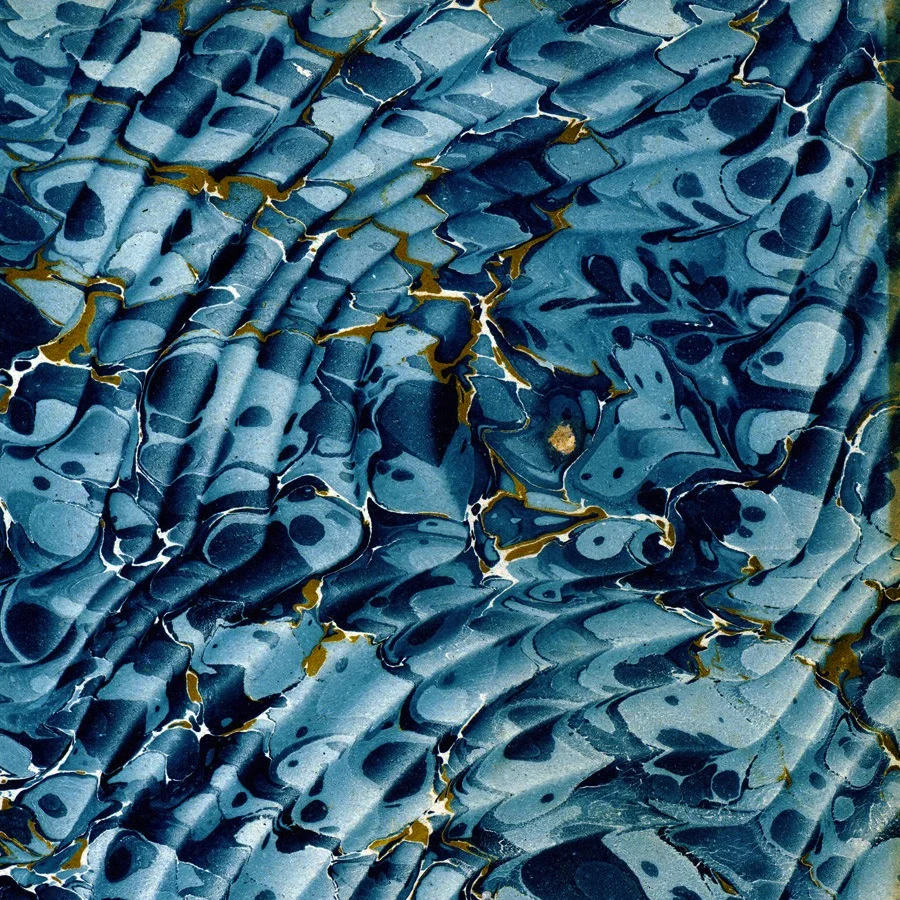
“The short answer is that what CERN has observed is consistent with the existence of a Higgs boson but that the number of candidate ‘Higgs events’ falls short of the number required to announce the result with more than about 50% certainty. A slightly longer answer is that experiments like ATLAS and CMS produce results that are ambiguous. The particle is highly unstable lasting only a fraction of a second before it decays. The experiments cannot see the particle directly, they can only see the debris left when the particle decays. A single event has multiple explanations. The decay of a Higgs particle might have given rise to a particular set of tracks but so might many other processes. The only way to be sure is to perform the experiment over and over again until there are enough events to distinguish statistically.”

Isabelle Cornaro
“The unknown that is at stake in research is neither an object nor a subject. The speech relation in which the unknown articulates itself is a relation of infinity. Hence it follows that the form in which this relation is realized must in one way or another have an index of “curvature” such that the relations of A to B will never be direct, symmetrical, or reversible, will not form a whole, and will not take place in a same time; they will be, then, neither contemporaneous nor commensurable.”
“Emptiness, by contrast, is a condition that modernism treasures. Pli selon pli reminds one of that. But I am not aware of an artist before Richter who tries to make pictorial intensity out of a kind of fullness - a stuffed-fullness, or at least a heavy impenetrability- that has no specific substance to its parts, no feeling of its constituent colours and textures having been hit precisely by the maker, fixed inevitably, in all their unique particularity.”
Newcomb's paradox →
“I don’t like Helvetica because of its authority, and I find it a clumsy typeface. I don’t know if I find it clumsy because of its association or I just find it aesthetically clumsy, but I try to avoid it.
I have attempted to devote the majority of my adult life to placing work within structures where they would function irregardless [sic] of what culture they found themselves in. That was a little bit of an aesthetic problem for people in the beginning, but I think in 2008 it’s not any longer questioned. […] I think in nouns, as a general rule – and you can’t communicate with people when you think just in nouns – so I basically have to then figure out a way to place it in a means that other people can see this as a specific object. That’s my job as an artist. That’s what I do here: that’s what you do in a studio. Occasionally I’ll draw something to understand a position. The drawings themselves are not sculpture or anything. They are dealing with things that find themselves on the table, or find themselves in the middle of the room, and how I looked at it in the moment.[…]Art is something that’s looking for a place and banging against the walls, and that’s what you think in terms of shaking things up. It’s just looking for some place to be. Once it finds that place, it’s no longer art; it’s some sort of thing; it’s culture. An artist is never supposed to assume authority. You think it – you can think anything you damn well please, but you don’t assume it within the work.[…]I just went back to a typeface I had been working on – I never had the time to devote to it – and devoted myself to it, and it’s a very simple typeface, and it seems to be functioning for a while; and I guess one morning I’ll work up and it will have entered into the culture in such a way that I’ll try to find another typeface. Maybe, happily, there’s a need for what I do. Maybe there won’t be one day – you never know.”
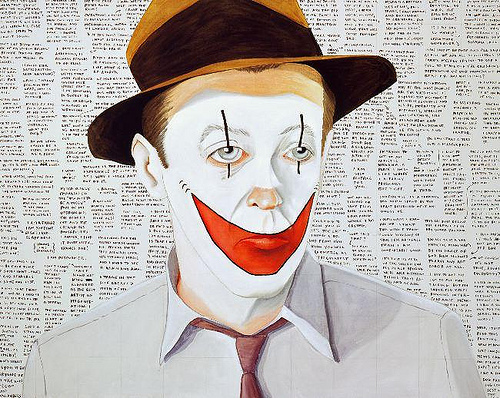
Sean Landers’ Ego, 2009
“Meaning takes place in the symbolic, is constantly negotiated through language (be this spoken or visual), through the dynamism of metaphor, structured by desire, power, gender and the rest. This process is open, ongoing and - most importantly - contestable. That’s why we have art in the first place.”
Curiosity →
Quadrature Ghost →
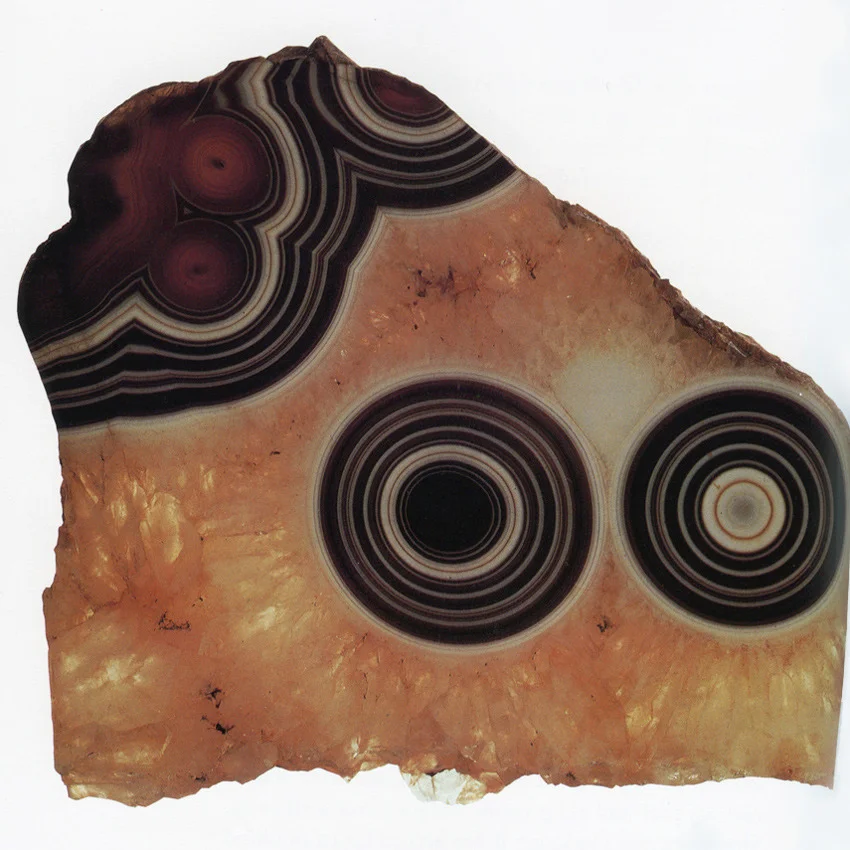
found on but does it float