• SELECTED PROJECTS
  • NEWS
  • NOTES
  • CV
  • CONTACT

Cody Trepte

  • SELECTED PROJECTS
  • NEWS
  • NOTES
  • CV
  • CONTACT
Jorinde VoigtDouglas R. Hofstadter, Gödel, Escher, Bach, „Die Air in G“,Achilles und die Schildkröte, 2013 Ink, pencil, gold leaf on paper262 x 152 cm

Jorinde Voigt
Douglas R. Hofstadter, Gödel, Escher, Bach, „Die Air in G“,Achilles und die Schildkröte, 2013
Ink, pencil, gold leaf on paper
262 x 152 cm

Tuesday 05.28.13
Posted by Cody Trepte
 
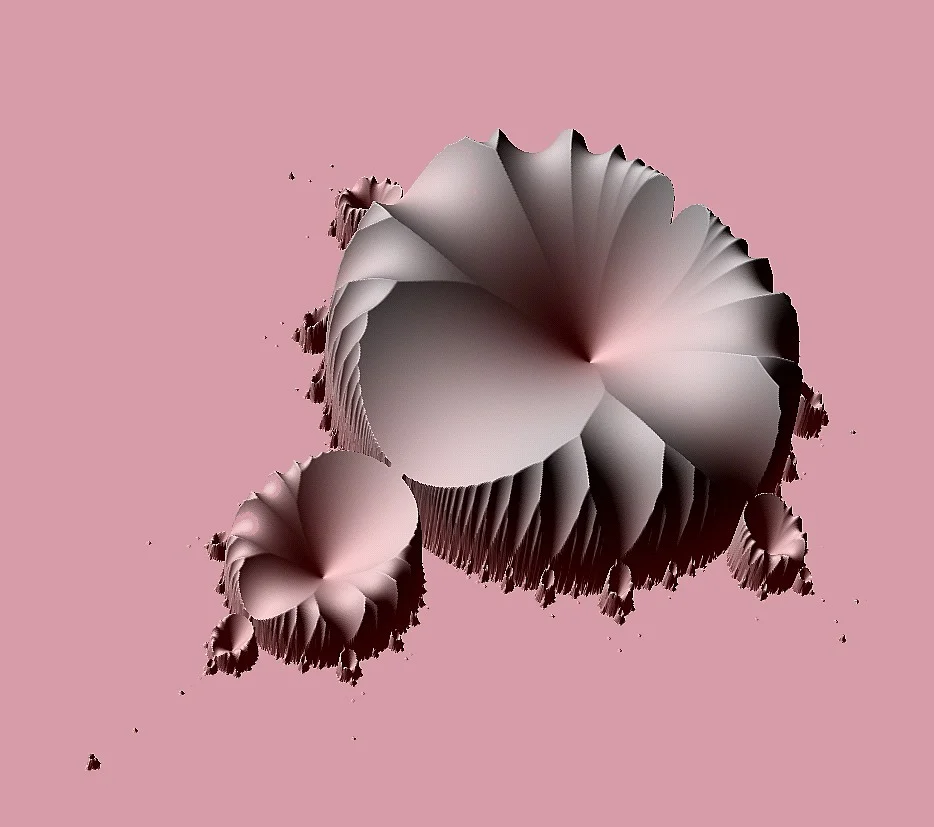
smallest absolute value of the orbit of the interior points of the mandelbrot set

smallest absolute value of the orbit of the interior points of the mandelbrot set

Sunday 05.26.13
Posted by Cody Trepte
 
“

A direct perception is present when I have it, and so is what is simultaneous with it. In the first place this definition involves a circle, for the words “when I have it,” can only mean “when it is present”. But if we left out these words, the definition would be false, for I have many direct presentations which are at different times, and which cannot, therefore, all be present, except successively. This, however, is the fundamental contradiction of the A series, which has been already considered. The point I wish to consider here is different.


The direct perceptions which I now have are those which now fall within my “specious present”. Of those which are beyond it, I can only have memory or anticipation. Now the “specious present ” varies in length according to circumstances, and may be different for two people at the same period. The event M may be simultaneous both with X’s perception Q and Y’s perception R. At a certain moment Q may have ceased to be part of X’s specious present. M, therefore, will at that moment be past. But at the same moment R may still be part of Y’s specious present. And, therefore, M will be present, at the same moment at which it is past.


This is impossible. If, indeed, the A series was something purely subjective, there would be no difficulty. We could say that M was past for X and present for Y, just as we could say that it was pleasant for X and painful for Y. But we are considering attempts to take time as real, as something which belongs to the reality itself, and not only to our beliefs about it, and this can only be so if the A series also applies to the reality itself. And if it does this, then at any moment M must be present or past. It cannot be both.

”
— The Unreality of Time by John Ellis McTaggart
Thursday 05.23.13
Posted by Cody Trepte
 
Peles Empire, Cabana IV, 2012

Peles Empire, Cabana IV, 2012

Sunday 05.19.13
Posted by Cody Trepte
 
Jesse Hlebo – All That Fits, 2012

Jesse Hlebo – All That Fits, 2012

Friday 05.17.13
Posted by Cody Trepte
 
Lucie Stahl – Face Off, 2012

Lucie Stahl – Face Off, 2012

Friday 05.17.13
Posted by Cody Trepte
 
tumblr_mmeaehDhb61qbgkzxo1_1280.jpg
Monday 05.06.13
Posted by Cody Trepte
 
“The hundred pages of that remarkable essay ring changes on a single geometrical theme: Euler’s law that the faces and vertices of a polyhedron together outnumber the edges by two. After explaining the classical proof, Lakatos produces an exception: a hollow solid whose surfaces are a cube within a cube. Its faces and vertices outnumber its edges by four. Then he examines the classical proof to see how it falls foul of such examples, and what stipulations would be suitable for excluding them. Having thus narrowed the scope of Euler’s law, he produces a further exception: a solid consisting of two tetrahedra with only an edge or vertex in common. A further tightening of the law is thus indicated, and still the exceptions are not at an end. A polyheron with a square tunnel through it occasions a further restriction; a cube with a penthouse on top occasions yet a further restriction; and so the dialectic of revision and exception goes its oscillating way.

The geometry is fascinating, but the purspose is philosophical. Lakatos is opposing the formalists’ conception of mathematical proofs, which represents them as effectively testable and, once tested, incontrovertible. He is opposing the notion, so central to logical positivism, that mathematics and natural science are methodologically unlike.”
— W. V. Quine’s review of Proofs and Refutations
Friday 05.03.13
Posted by Cody Trepte
 

Corrasable - Damon Zucconi →

Corrasable an API that packages together tools like Lingua and The CMU Pronouncing Dictionary to assist in analyzing text and converting it into alternate representations.

Wednesday 04.24.13
Posted by Cody Trepte
 
Myoung Ho Lee

Myoung Ho Lee

Wednesday 04.24.13
Posted by Cody Trepte
 
Wednesday 04.24.13
Posted by Cody Trepte
 
Jean Cocteau’s Orpheus

Jean Cocteau’s Orpheus

Sunday 04.21.13
Posted by Cody Trepte
 
“Why does it disturb us that the map be included in the map and the thousand and one nights in the book of the Thousand and One Nights? Why does it disturb us that Don Quixote be a reader of the Quixote and Hamlet a spectator of Hamlet? I believe I have found the reason: these inversions suggest that if the characters of a fictional work can be readers or spectators, we, its readers or spectators, can be fiction. In 1833, Carlyle observed that the history of the universe is an infinite sacred book that all men write and read and try to understand, and in which they are also written.”
— Partial Magic in the Quixote by Jorge Luis Borges
Wednesday 04.17.13
Posted by Cody Trepte
 
Saturday 03.23.13
Posted by Cody Trepte
 

Chronotopic Anamorphosis

Tuesday 03.19.13
Posted by Cody Trepte
 
“All languages are clearly alien and untrue, and, absent of so-called meaning, it is repeatedly clear that language is a social form of controlled weeping, a more sophisticated way to cry. To speak is to grieve, and I would prefer not to listen to a weeping animal all day and every day, sobbing and desperate and lost.”
— Ben Marcus, Notable American Women
Monday 03.04.13
Posted by Cody Trepte
 
BG = Polygon[ {ImageScaled[{0, 0}], ImageScaled[{1, 0}],  ImageScaled[{1, 1}], ImageScaled[{0, 1}]},  VertexColors -> {RGBColor[240/255, 237/255, 222/255], RGBColor[229/255, 226/255, 211/255],  RGBColor[228/255, 227/255, 209/255], RGBColor[214/25…

BG =
 Polygon[
{ImageScaled[{0, 0}], ImageScaled[{1, 0}],
 ImageScaled[{1, 1}], ImageScaled[{0, 1}]},
VertexColors ->
{RGBColor[240/255, 237/255, 222/255],
RGBColor[229/255, 226/255, 211/255],
RGBColor[228/255, 227/255, 209/255],
RGBColor[214/255, 215/255, 199/255]}];

Manipulate[
Graphics[
Table[
Rotate[
Table[
Table[
Line[
{{Mod[i + j/14 + (1 + r) t + r/2, 12], 0},
{Mod[i + j/14 + (1 + r) t + r/2, 12], 12}}],
{j, -i/2, i/2, 1}],
{i, 0, 12, 1}],
-r*Pi/2, {6, 6}],
{r, {0, 1}}],
PlotRange -> {{0, 11.5}, {0, 11.5}}, ImageSize -> 500, Prolog -> BG],
{{t, 11.05}, 0, 12}]

Tuesday 02.26.13
Posted by Cody Trepte
 
tumblr_miu7hs7hrl1qbgkzxo1_1280.jpg
Tuesday 02.26.13
Posted by Cody Trepte
 

In theory: the unread and the unreadable | Books | guardian.co.uk

If literature cannot be reduced to the production of books, neither can it be reduced to the production of meaning. Unreadability may even be a deliberate compositional strategy. In his influential essay on “The Metaphysical Poets”, TS Eliot draws the conclusion that modern poetry must become increasingly “difficult” in order “to force, to dislocate if necessary, language into its meaning”. The need to breathe life back into a moribund language corrupted by overuse, chimes with Stéphane Mallarmé’s endeavour to “purify the words of the tribe”. The French writer was very much influenced by Hegel, according to whom language negates things and beings in their singularity, replacing them with concepts. Words give us the world by taking it away. This is why the young Beckett’s ambition was to “drill one hole after another” into language “until that which lurks behind, be it something or nothing, starts seeping through”.

Literature (for the likes of Mallarmé and Blanchot) takes linguistic negation one step further, by negating both the real thing and its surrogate concept. As a result, words no longer refer primarily to ideas, but to other words; they become present like the things they negated in the first place. When critics objected that Joyce’s Finnegans Wake was unreadable, Beckett responded: “It is not to be read – or rather it is not only to be read. It is to be looked at and listened to. His writing is not about something; it is that something itself.” Unlike ordinary language, which is a means of communication, literary language resists easy, and even complete, comprehension. Words become visible; the bloody things keep getting in the way. From this perspective, the literary is what can never be taken as read. In a recent article, David Huntsperger gives an interesting contemporary twist to this debate. He views the opacity of some contemporary novels as a healthy corrective to our “clickthrough culture, where the goal of writing is to get you from one place to another as effortlessly as possible, so that (let’s be honest here) you can buy something”.

Wednesday 02.20.13
Posted by Cody Trepte
 
tumblr_mig41nGJc91qbgkzxo1_1280.jpg
Monday 02.18.13
Posted by Cody Trepte
 
Newer / Older