Impact on the comet's surface occurred 14.5 hours after its descent manoeuvre; the final data packet from Rosetta was transmitted at 10:39:28.895 UTC (SCET) by the OSIRIS instrument and was received at the European Space Operations Centre in Darmstadt, Germany, at 11:19:36.541 UTC. The spacecraft's estimated speed at the time of impact was 3.2 km/h (2.0 mph; 89 cm/s), and its touchdown location, named Sais by the operations team after the Rosetta Stone's original temple home, is believed to be only 40 m (130 ft) off-target. The final image transmitted by the spacecraft of the comet was taken by its OSIRIS instrument at an altitude of 20 m (66 ft) about 10 seconds before impact, showing an area 0.96 m (3.1 ft) across. Rosetta's computer included commands to send it into safe mode upon detecting that it had hit the comet's surface, turning off its radio transmitter and rendering it inert in accordance with International Telecommunication Union rules.
“Everything has become simulacrum, for by simulacrum we should not understand a simple imitation but rather the act by which the very idea of a model or privileged position is challenged and overturned. The simulacrum is the instance which includes a difference within itself, such as (at least) two divergent series on which it plays, all resemblance abolished so that one can no longer point to the existence of an original and a copy. It is in this direction that we must look for the conditions, not of possible experience, but of real experience (selection, repetition, etc.). It is here that we find the lived reality of a sub-representative domain. If it is true that representation has identity as its element and similarity as its unit of measure, then pure presence such as it appears in the simulacrum has the ‘disparate’ as its unit of measure - in other words, always a difference of difference as its immediate element.”
The People Who Collect Strangers' Memories →
“What I look for most of all is an unsolvable problem,” he concluded. “The answer is lost in the past.”
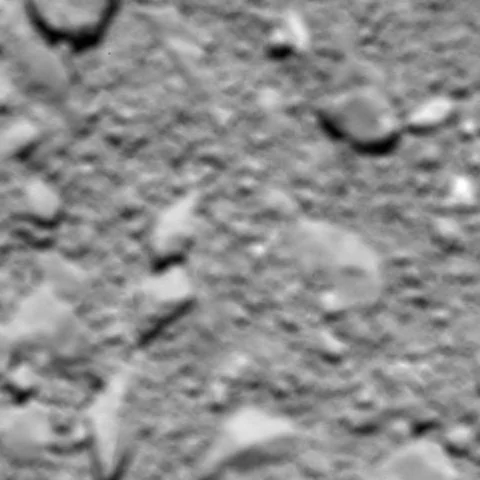
Rosetta's final image before impact on Comet 67P
This Long Century: Tom McCarthy →
A Mathematician's Apology by G.H. Hardy
I have never done anything 'useful'. No discovery of mine had made, or is likely to make, directly or indirectly, for good or ill, the least difference to the amenity of the world. I have helped to train other mathematicians, but mathematicians of the same kind as myself, and their work has been, so far at any rate as I have helped them into it, as useless as my own. Judged by all practical standards, the value of my mathematical life is nil; and outside mathematics it is trivial anyhow. I have just one chance of escaping a verdict of complete triviality, that I may be judged to have created something worth creating. And that I have created something is undeniable: the question is about its value.
etaoin shrdlu
A Brief History Of Books That Do Not Exist →
There Is No Scientific Method →
About half past eight last night I was transmitting at forty watts

“A proxy in one sense is a position: a stand-in, an agent, an avatar, a functionary, and I am acquainted with the office. I have been stepson, house sitter, replacement faculty, liaison, trustee, interim director, secretary, adjunct, sub, temp, warm body, and for a short while acting editor of The Prostate–I still have the letterhead. Whose office is this? is a deputy’s question to answer, a tricky one, and also On whose behalf; on what authority do you have it?
In sciences I think proxy additionally expresses a kind of concession to imprecision, a failure. It’s the word for a subject you choose to study to produce data that can approximate the data you’d get from the actual, desired subject, if it were not prohibitively hard to apprehend.
”
“We all see our lives as stories, it seems to me, and I am convinced that psychologists and sociologists and historians and so on would find it useful to acknowledge that. If a person survives an ordinary span of sixty years or more, there is every chance that his or her life as a shapely story has ended, and all that remains to be experienced is epilogue. Life is not over, but the story is.”
“The poor image is a copy in motion. Its quality is bad, its resolution substandard. As it accelerates, it deteriorates. It is a ghost of an image, a preview, a thumbnail, an errant idea, an itinerant image distributed for free, squeezed through slow digital connections, compressed, reproduced, ripped, remixed, as well as copied and pasted into other channels of distribution. …
The poor image is no longer about the real thing—the originary original. Instead, it is about its own real conditions of existence: about swarm circulation, digital dispersion, fractured and flexible temporalities. It is about defiance and appropriation just as it is about conformism and exploitation.”

Rule 90